1

EOUP, 2018

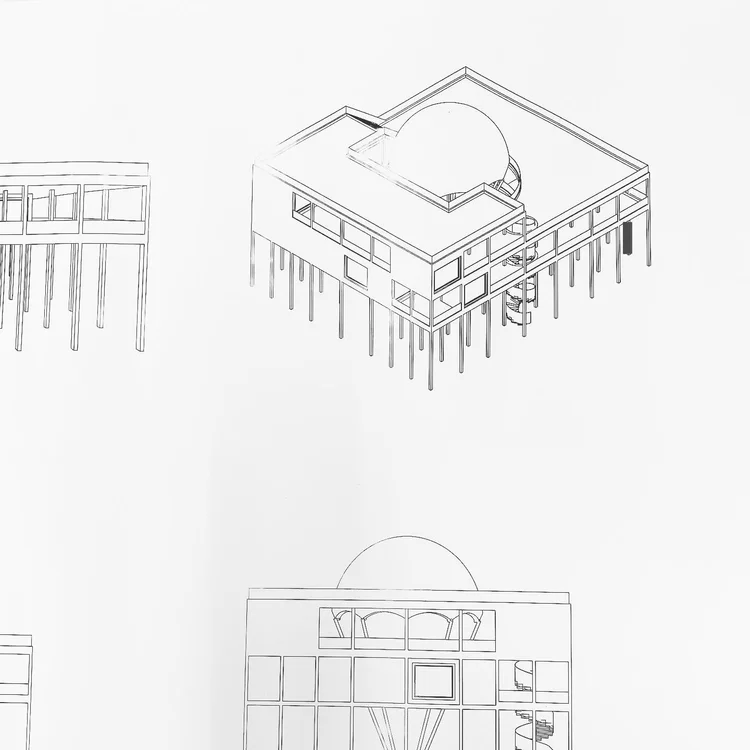
Paper Architecture / Installation. Commissioned by The Qattan Art Foundation for YAYA 2018.

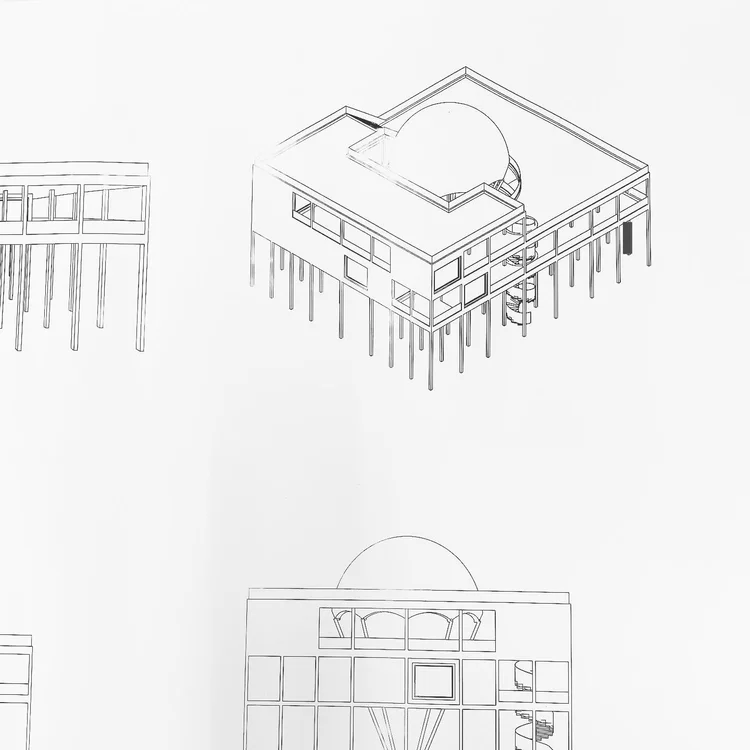
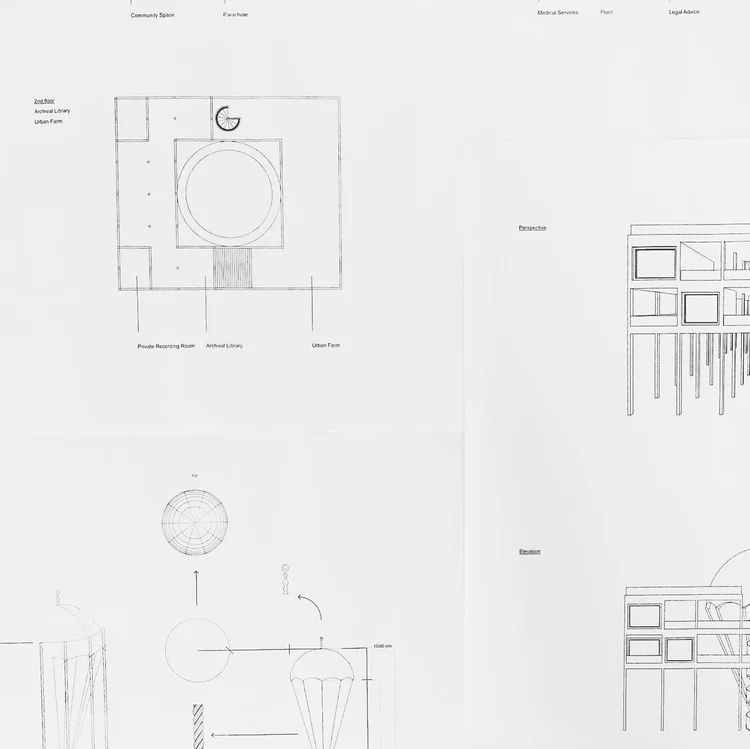
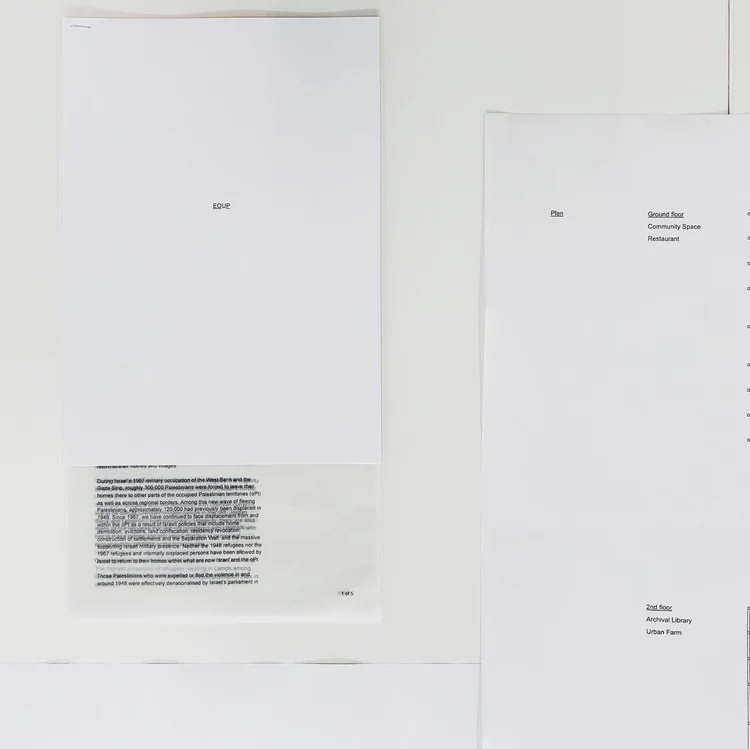
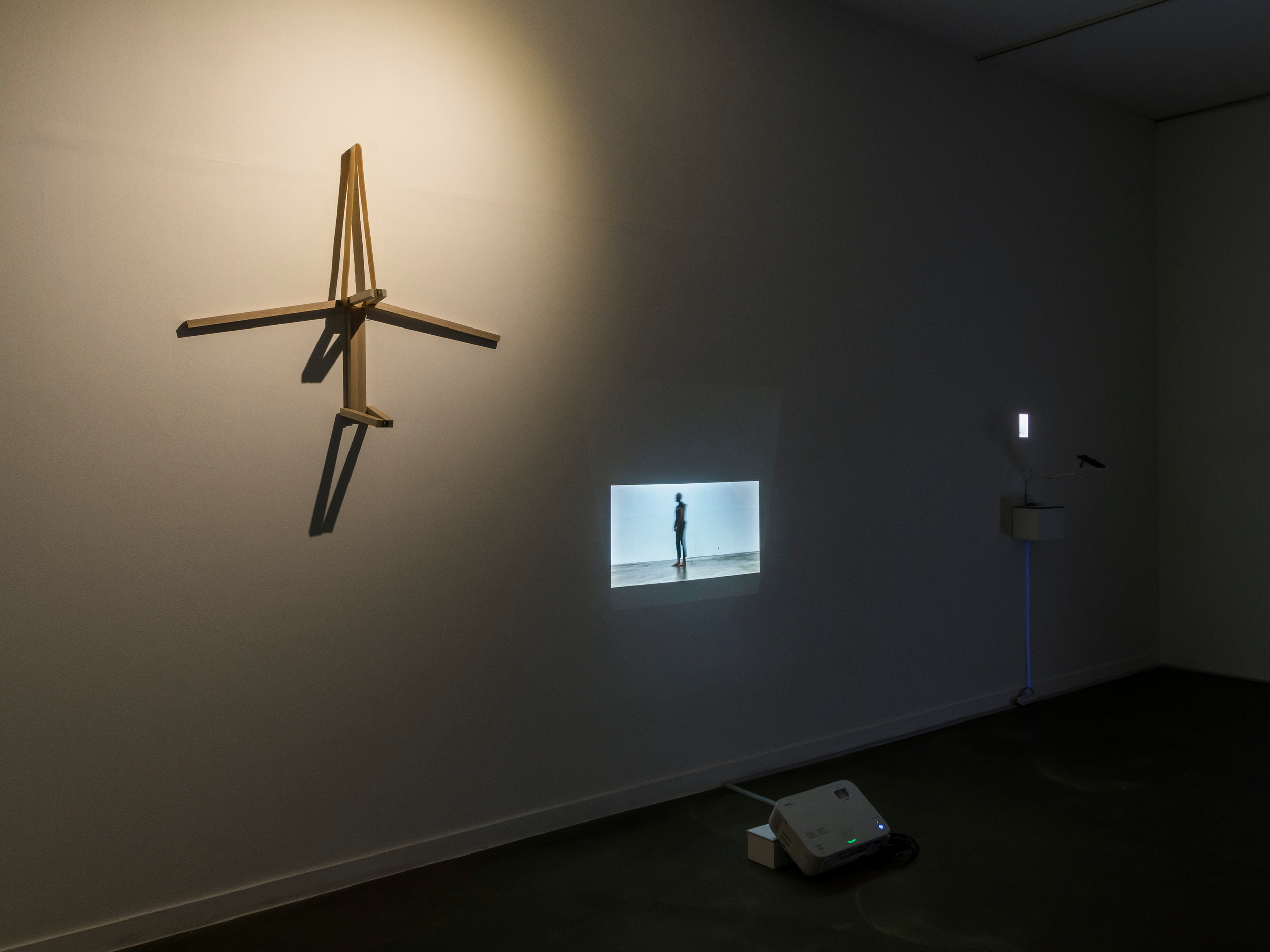
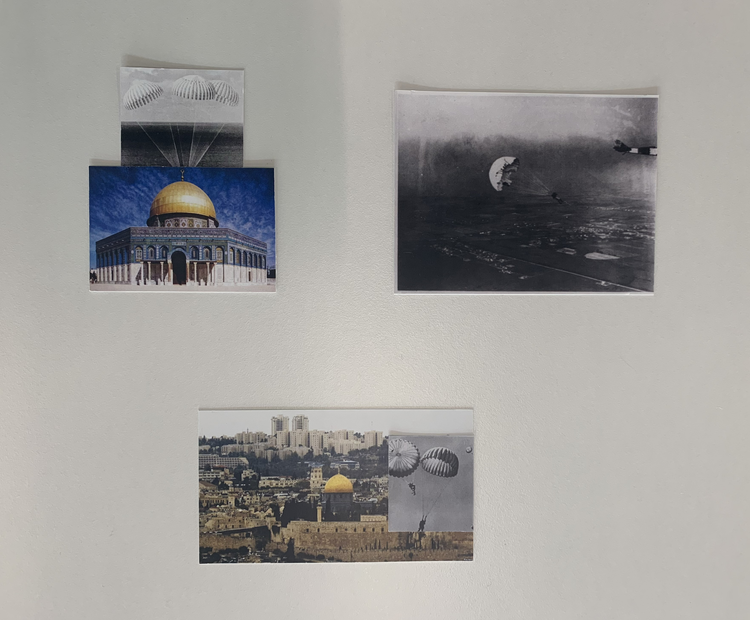
Proposes a hypothetical organisation that works on providing relief for Palestinian Refugees residing outside of the PLO mandates or UNRWA jurisdiction.1 Hosted within a structure that mixes the iconography of the Dome of the Rock with the mechanism of parachuting in an architectural image that identifies its purpose as a body of aid to Palestinians.2

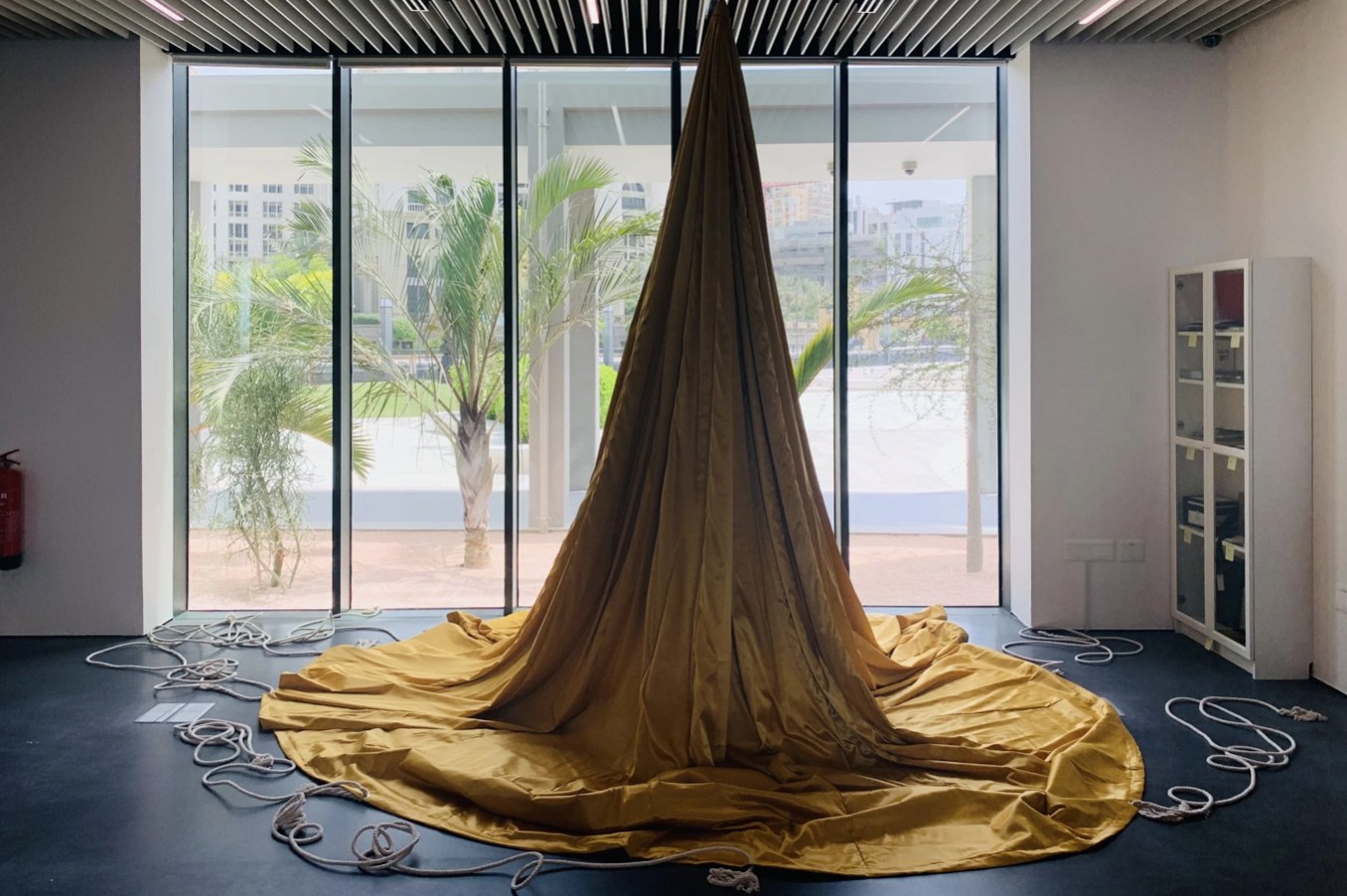
EOUP installed at Library Circles, James Art Center, Dubai
Library Circles, James Art Center, Dubai
2

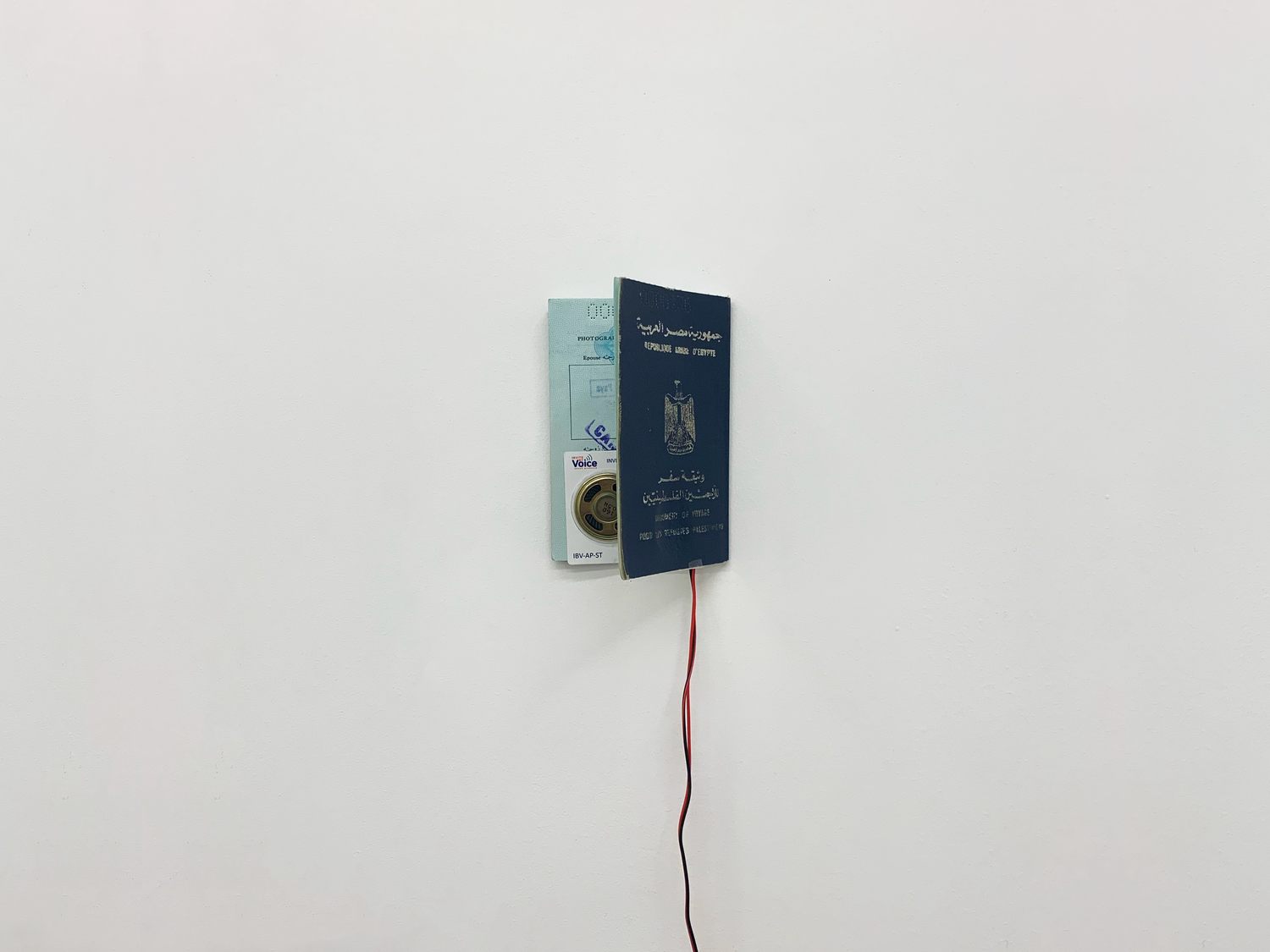
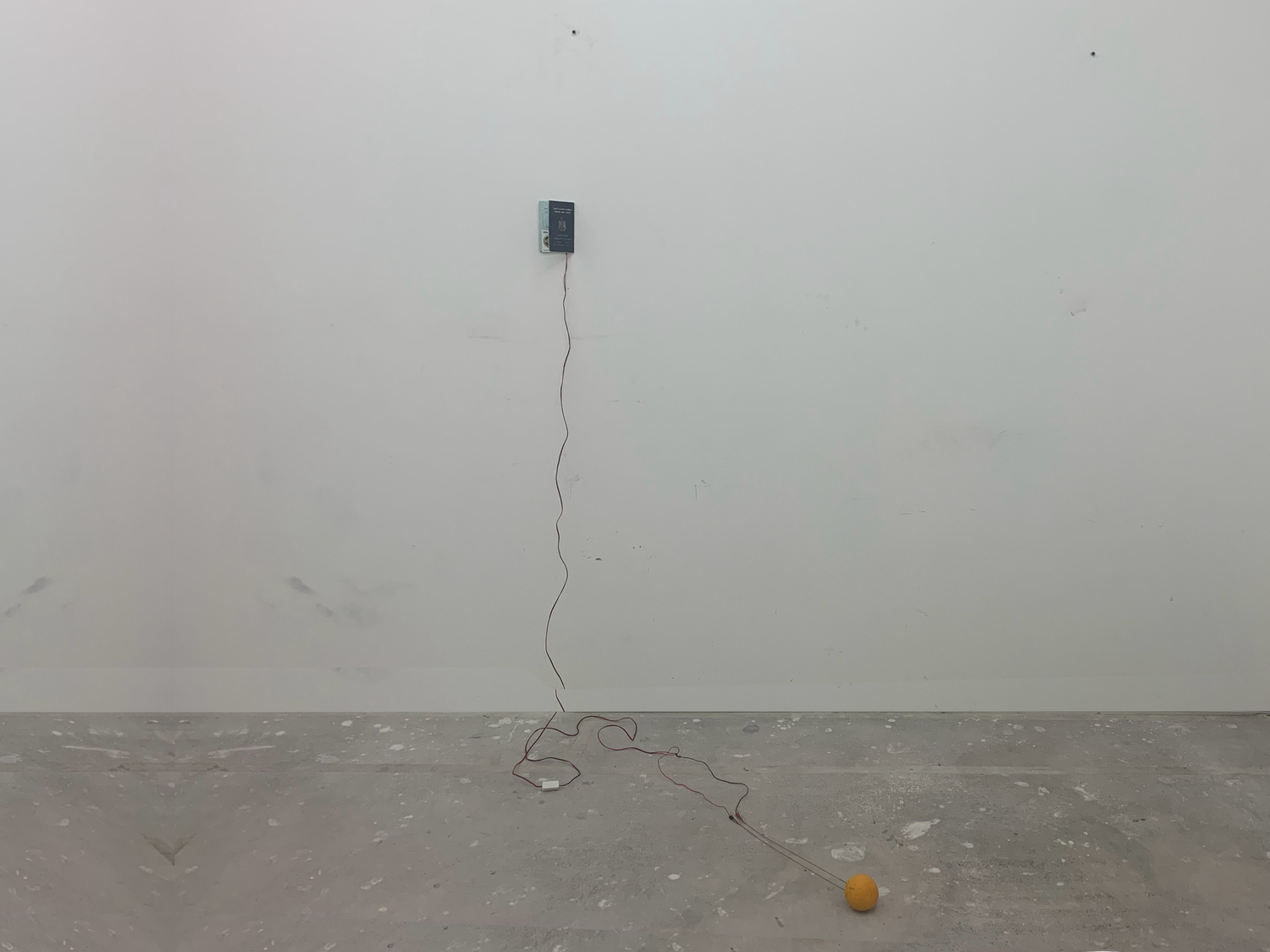
Forbidden Fruit

Modified Object / Sound Installation. Refugee document, greeting card sound module, Yafa orange.

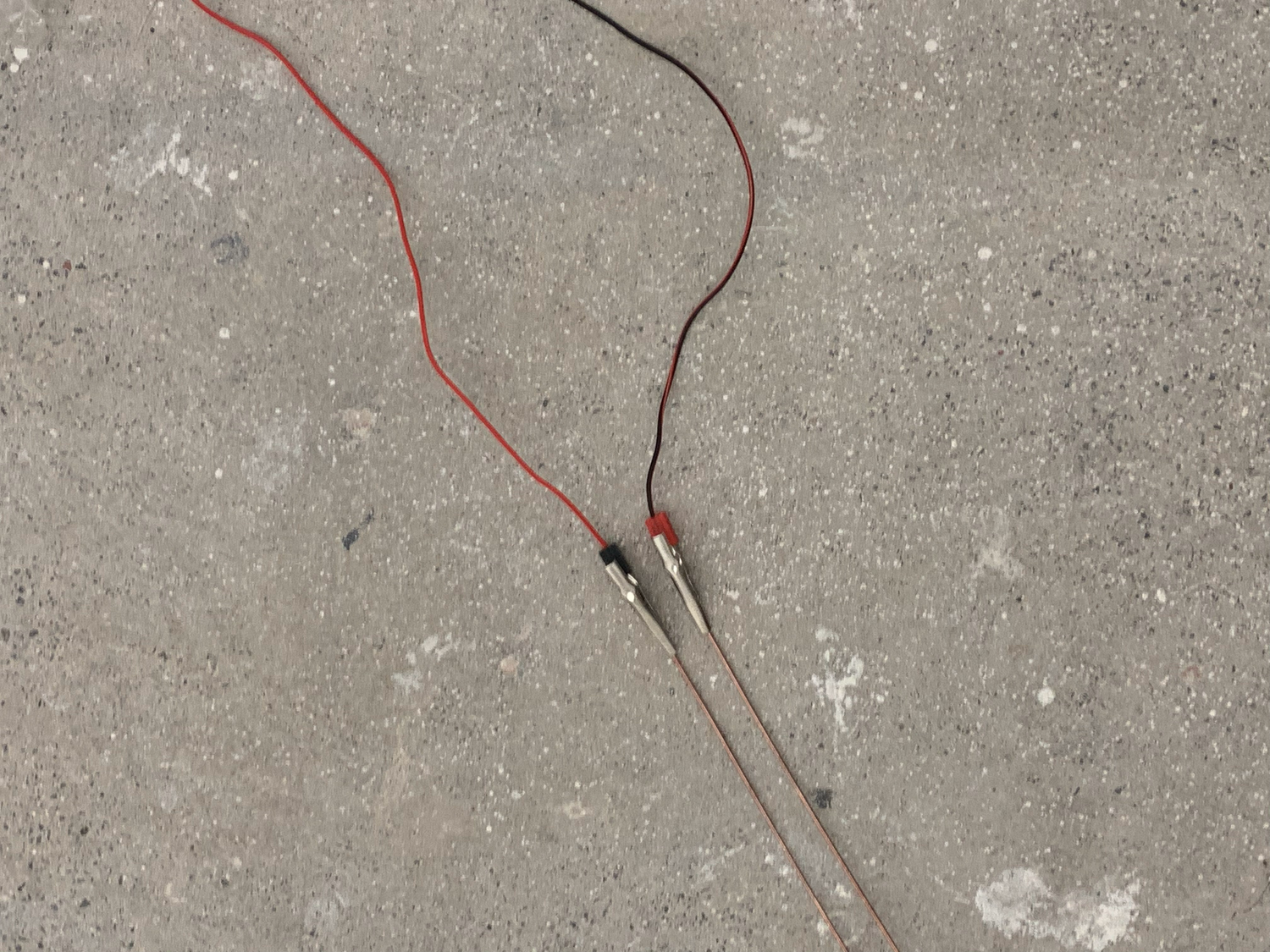
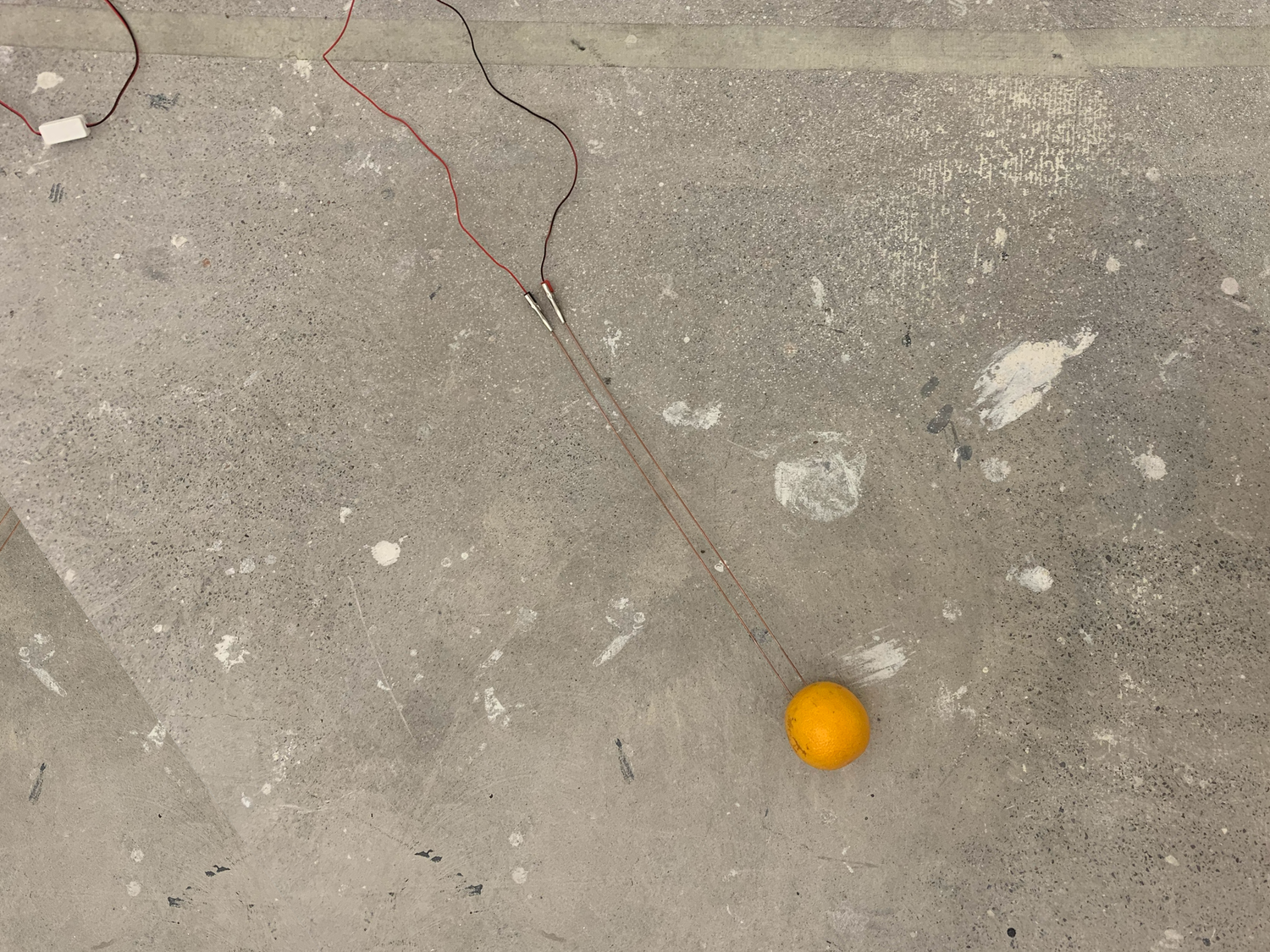
A sound module is embedded into the refugee document and wired directly to the fruit. The acidity of the orange powers the circuit. When the document is opened, the device plays a standard Hebrew birthday song, creating a parasitic loop between indigenous resources and the language of the occupier.

3

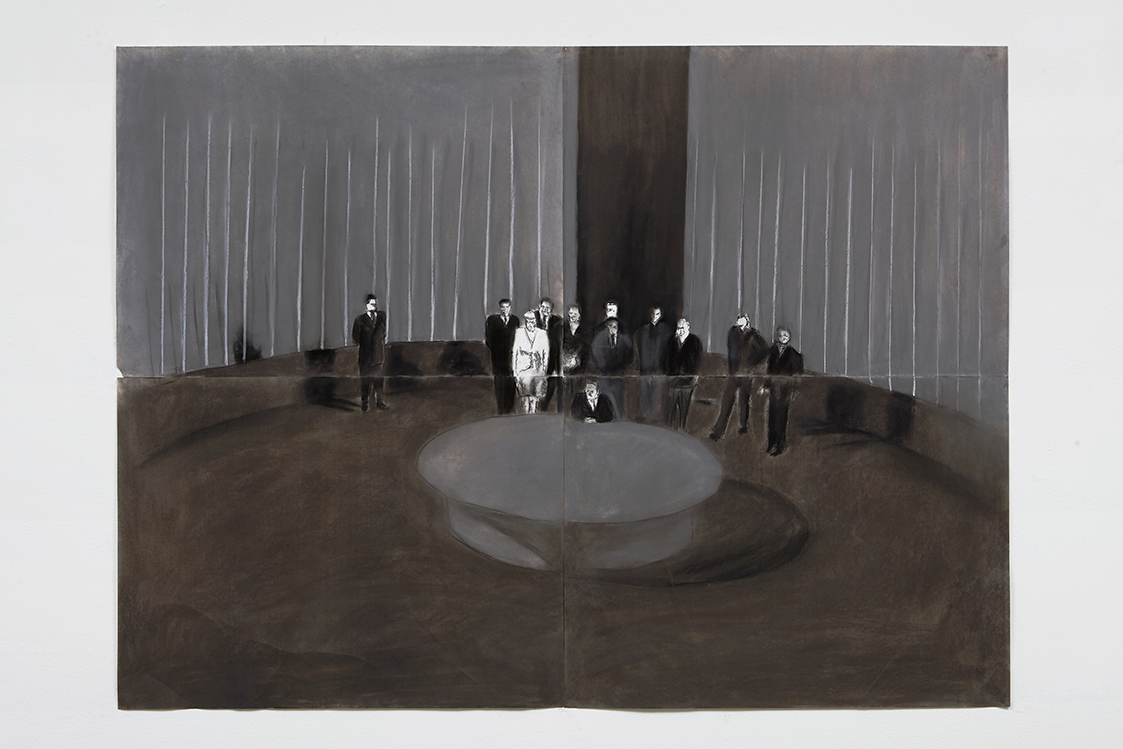
Eternity Of Silence

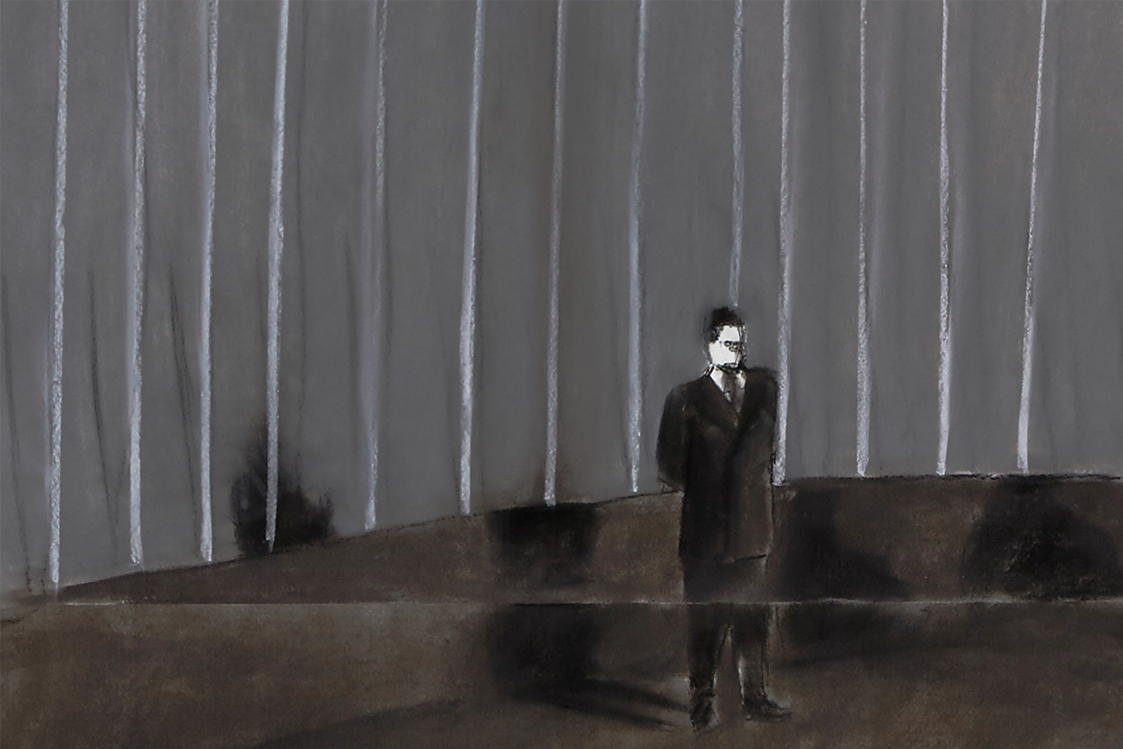
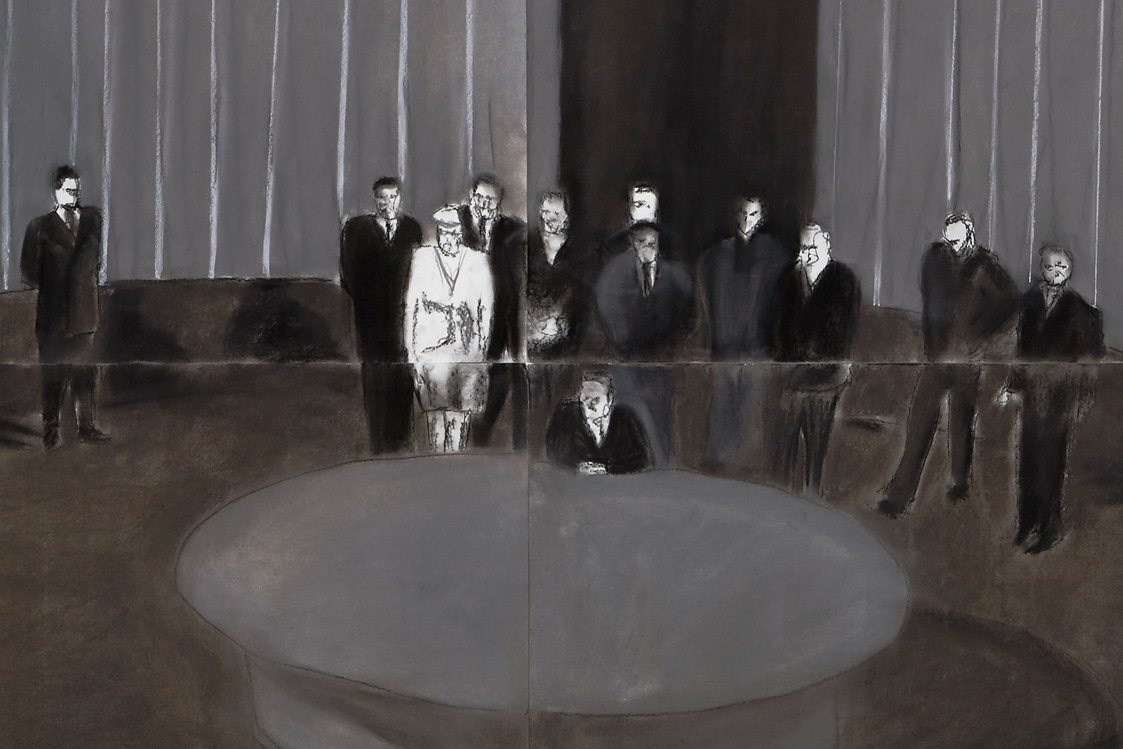
Pastel on Paper. 2x1.7m. Barjeel Art Foundation Collection. Created under MMCA South Korea Residency Program.

Depicts the historical signing of the U.N. Charter with all national flags removed from the scene. The redaction renders the event absurd, visualizing the silence within international legal frameworks.

4

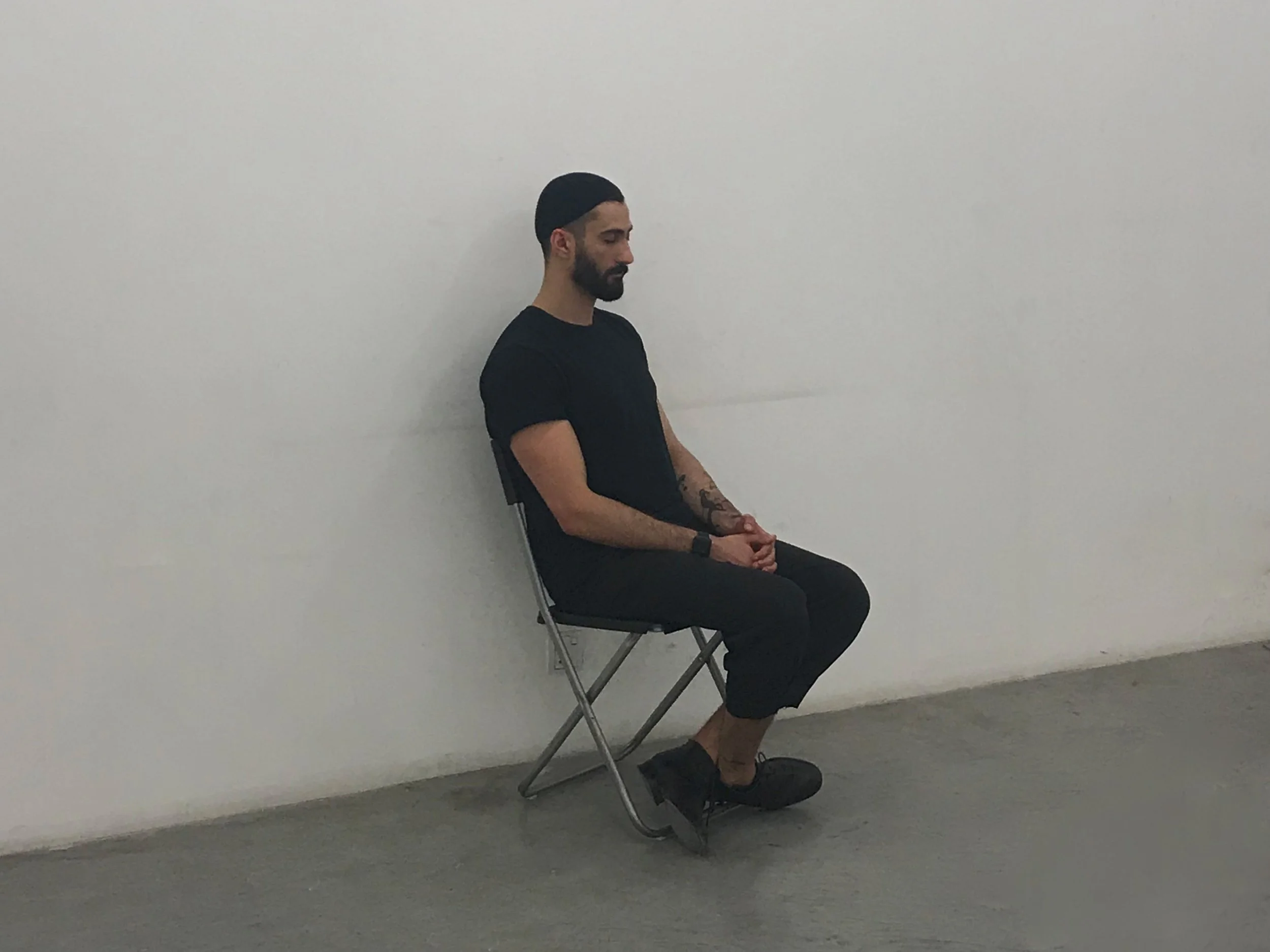
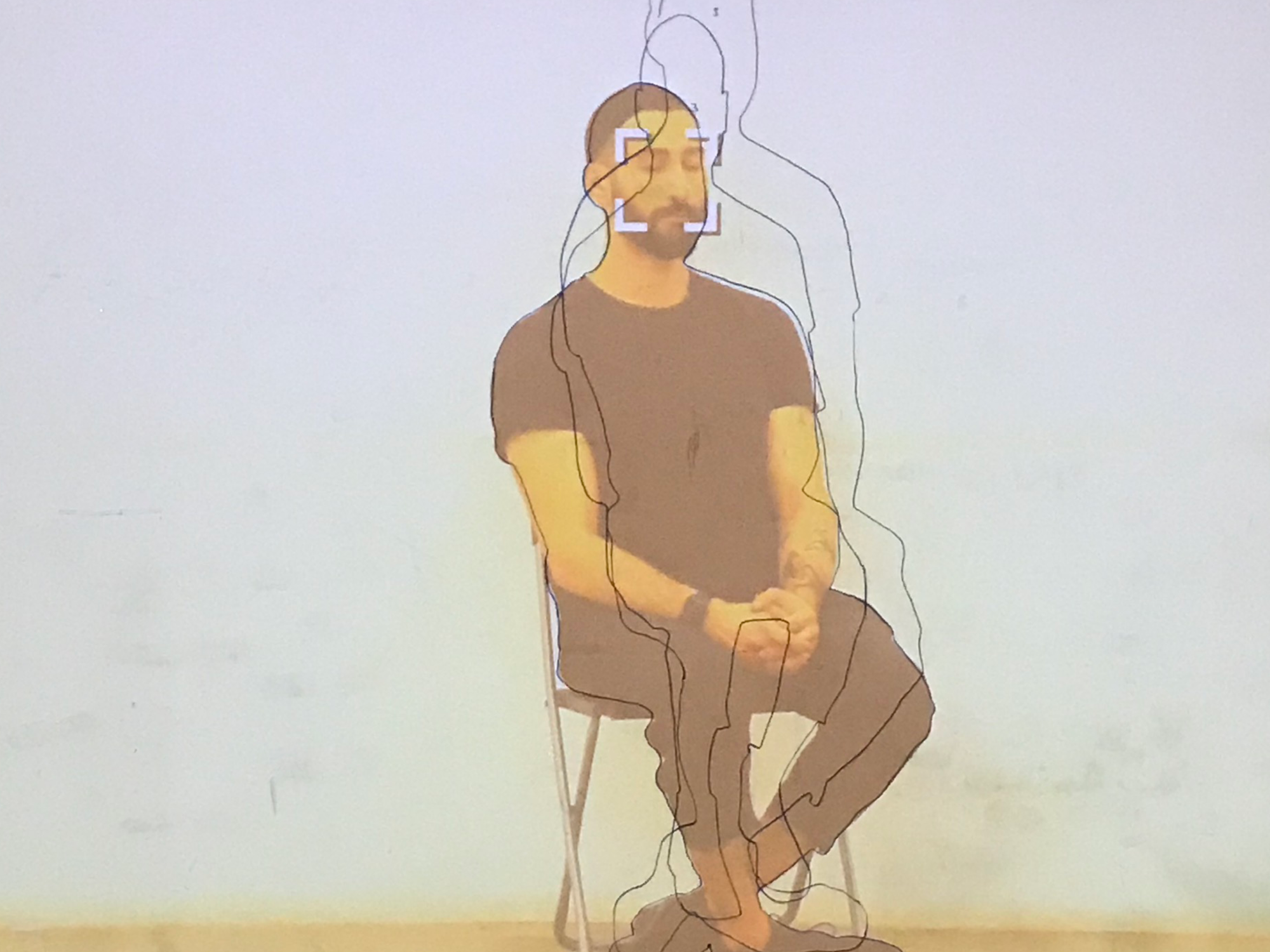
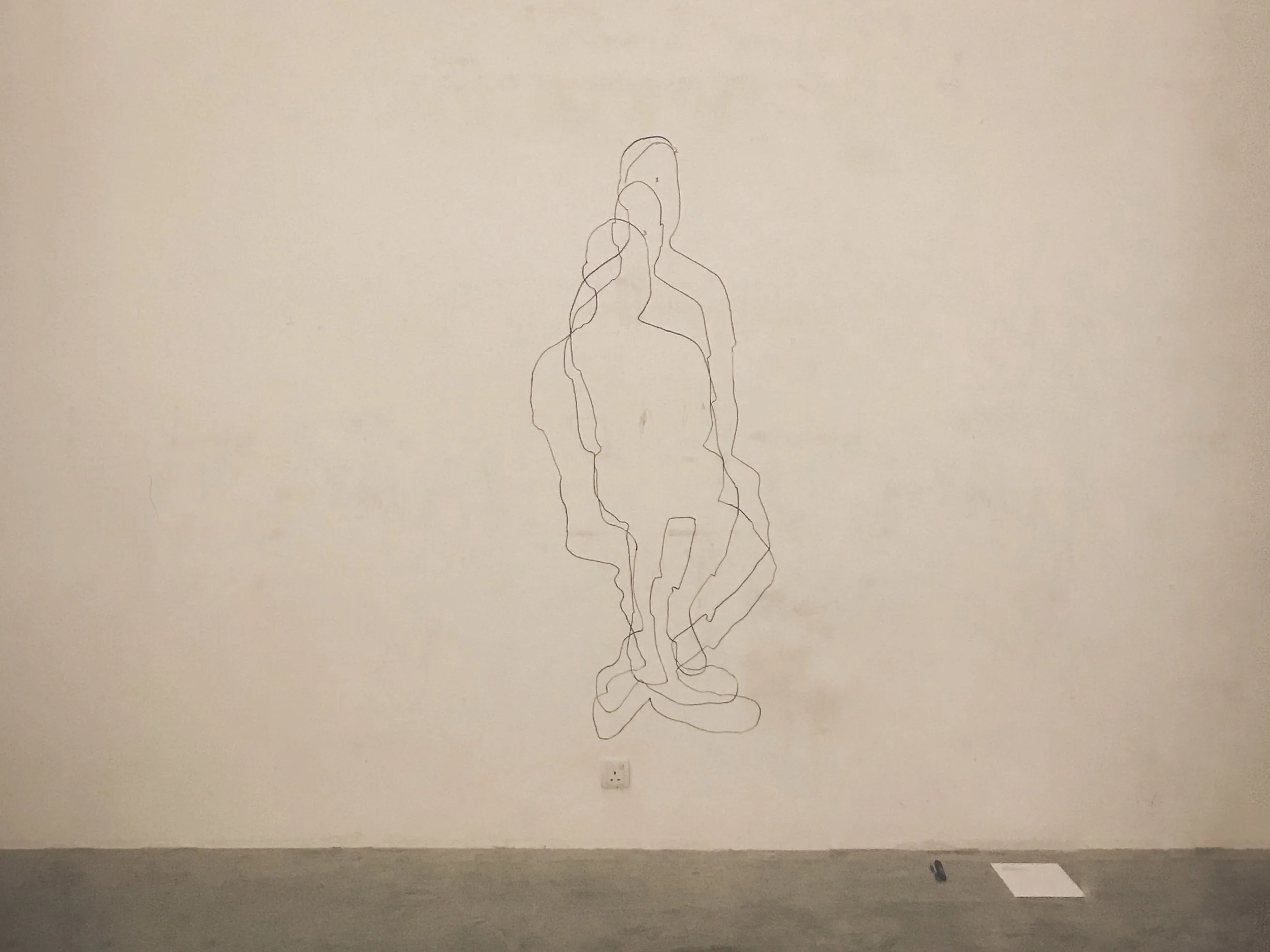
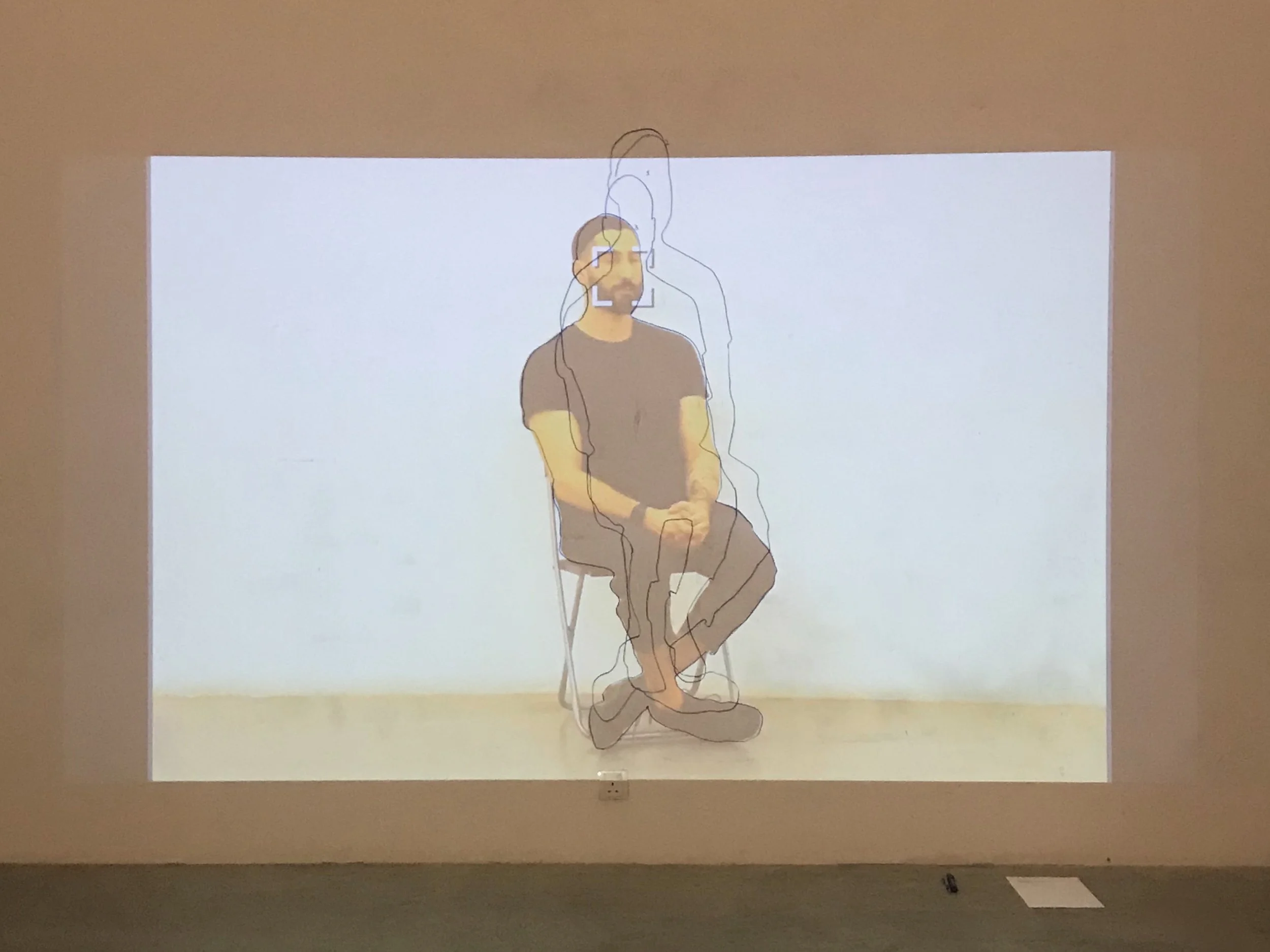
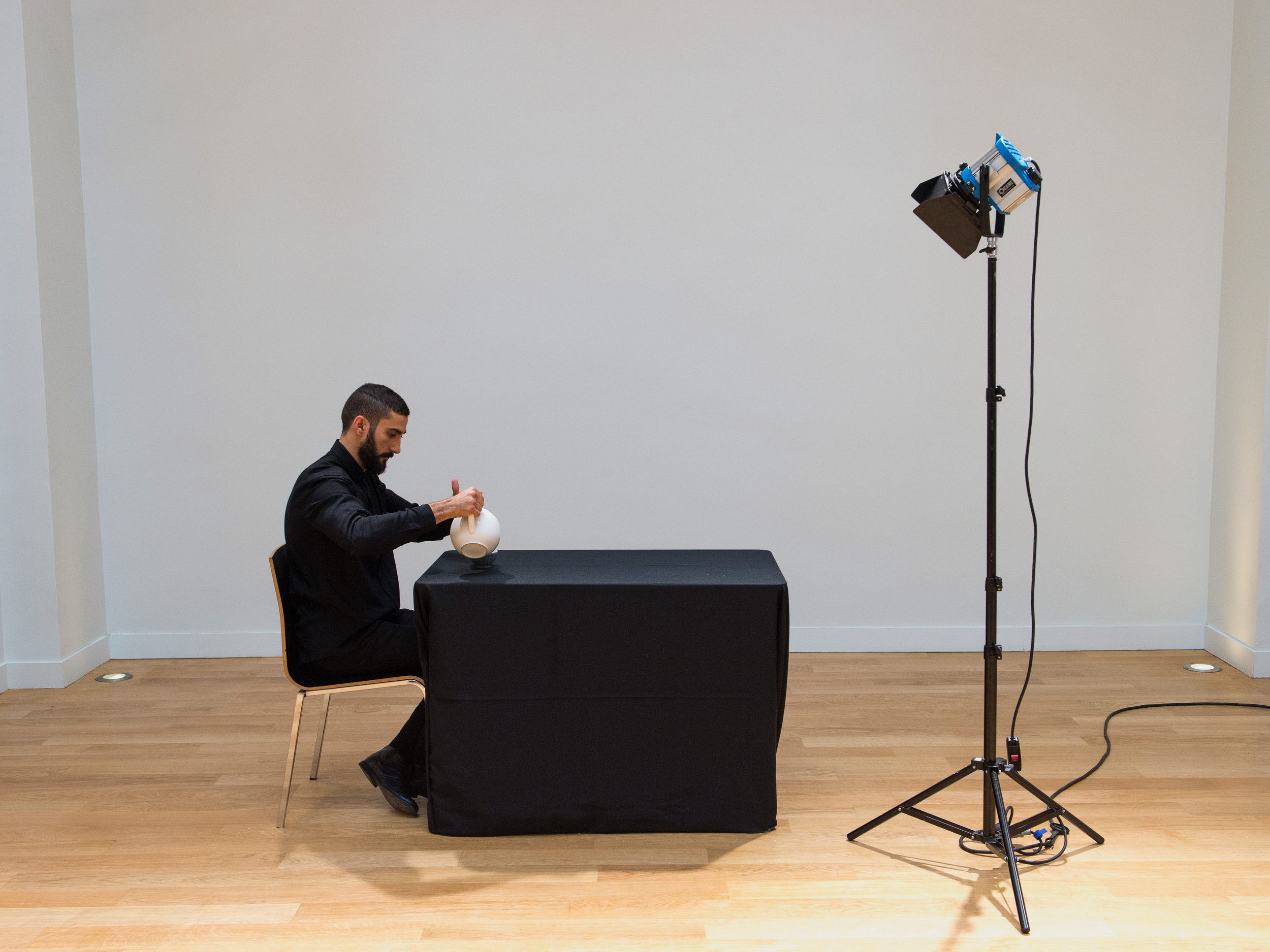
Inaudible Dialogue

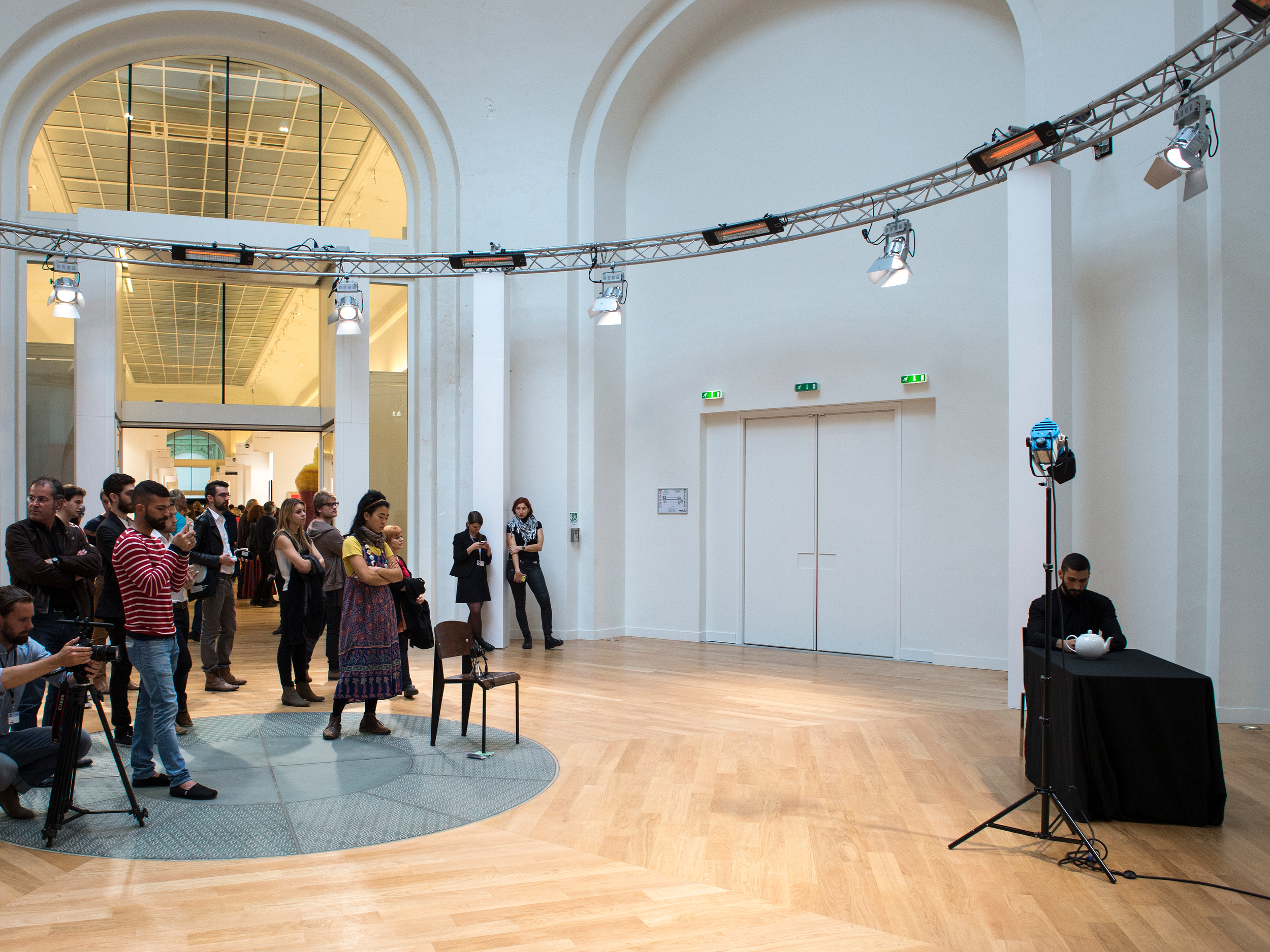
Durational Performance / Participatory Installation. 4 hours.

The artist attempts to sit still for the duration of the performance. Participants trace the projected video feed, documenting every involuntary movement as a visible deviation from the ideal form, while the artist struggles to remain within the boundaries of his own shape.

5

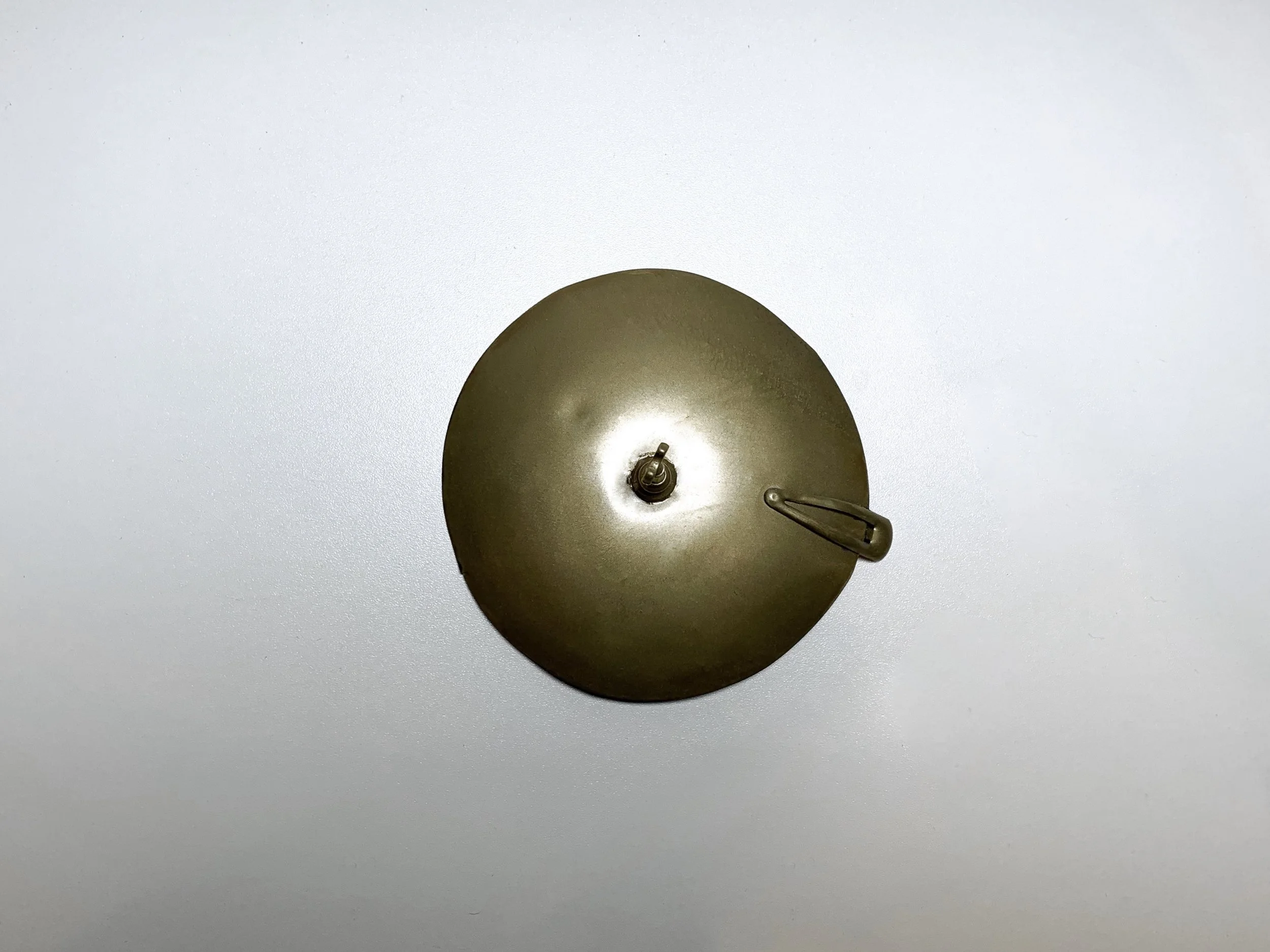
Qibla

Brass Sculpture. Wearable object. Variable dimensions.

A wearable sculpture merging the form of a Jewish Kippah with the architecture of the Dome of the Rock. By collapsing these two contested symbols into a single object, the work physically places the geopolitical burden of the "Holy Site" directly onto the head of the individual.

6

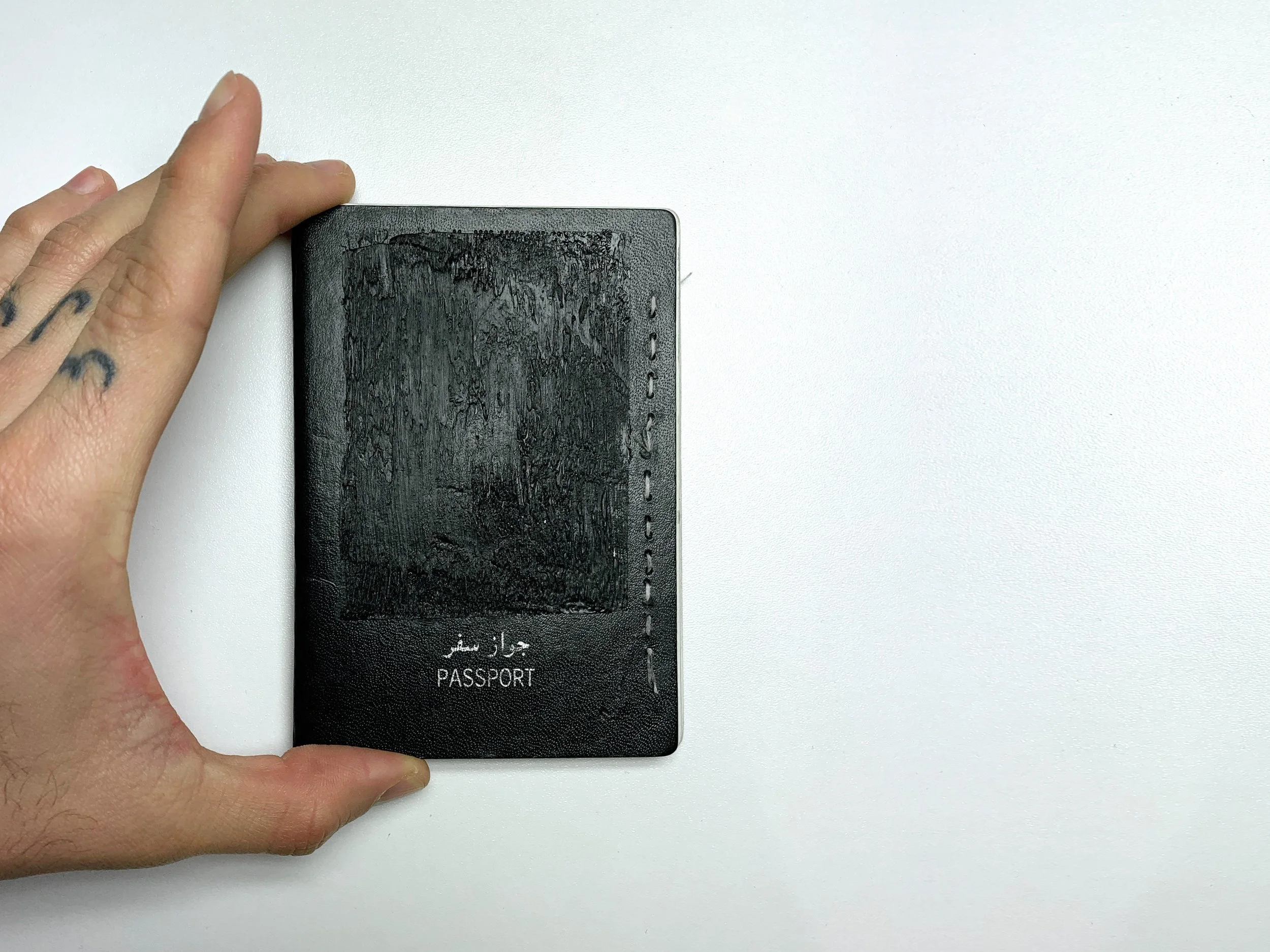
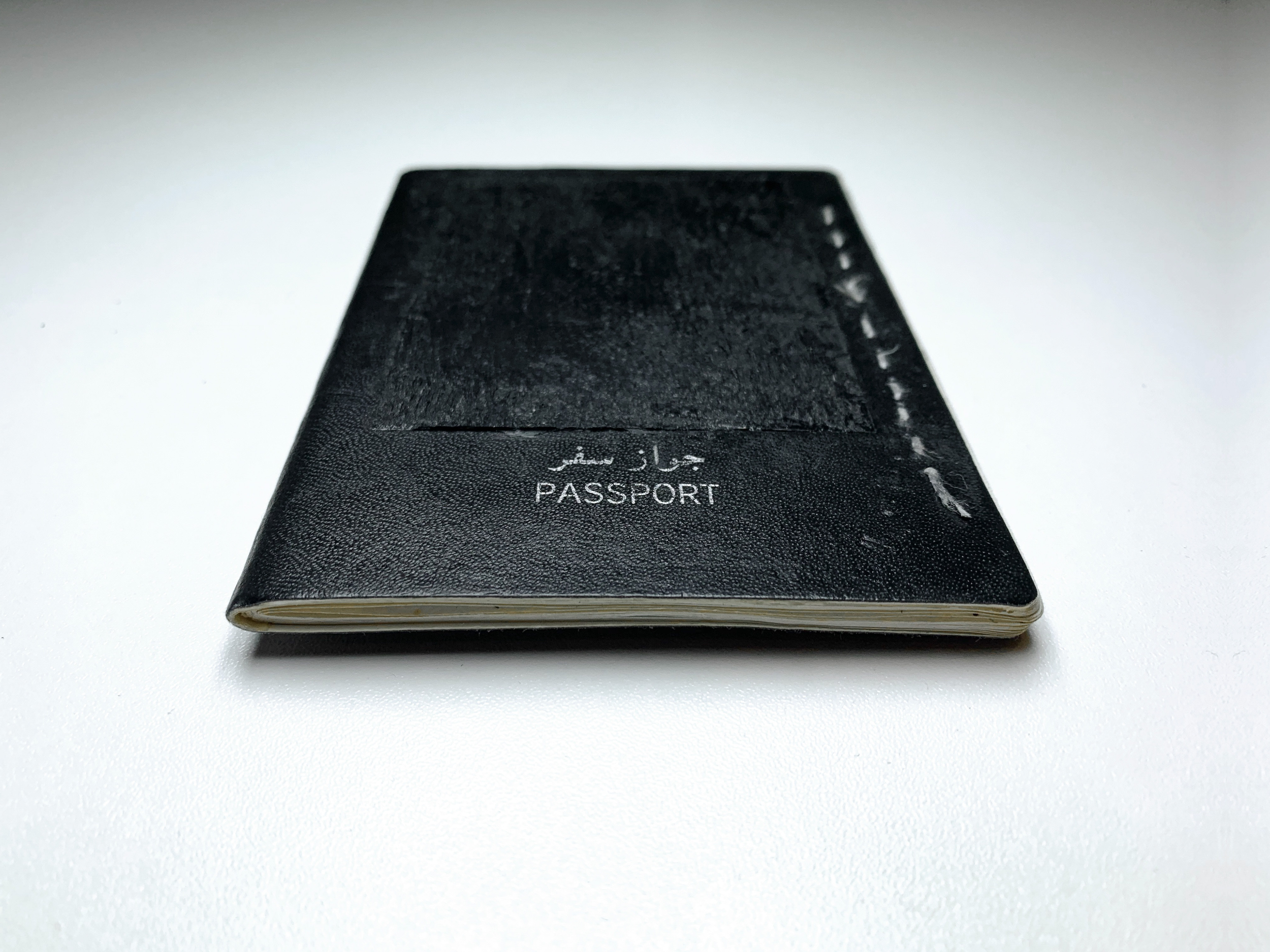
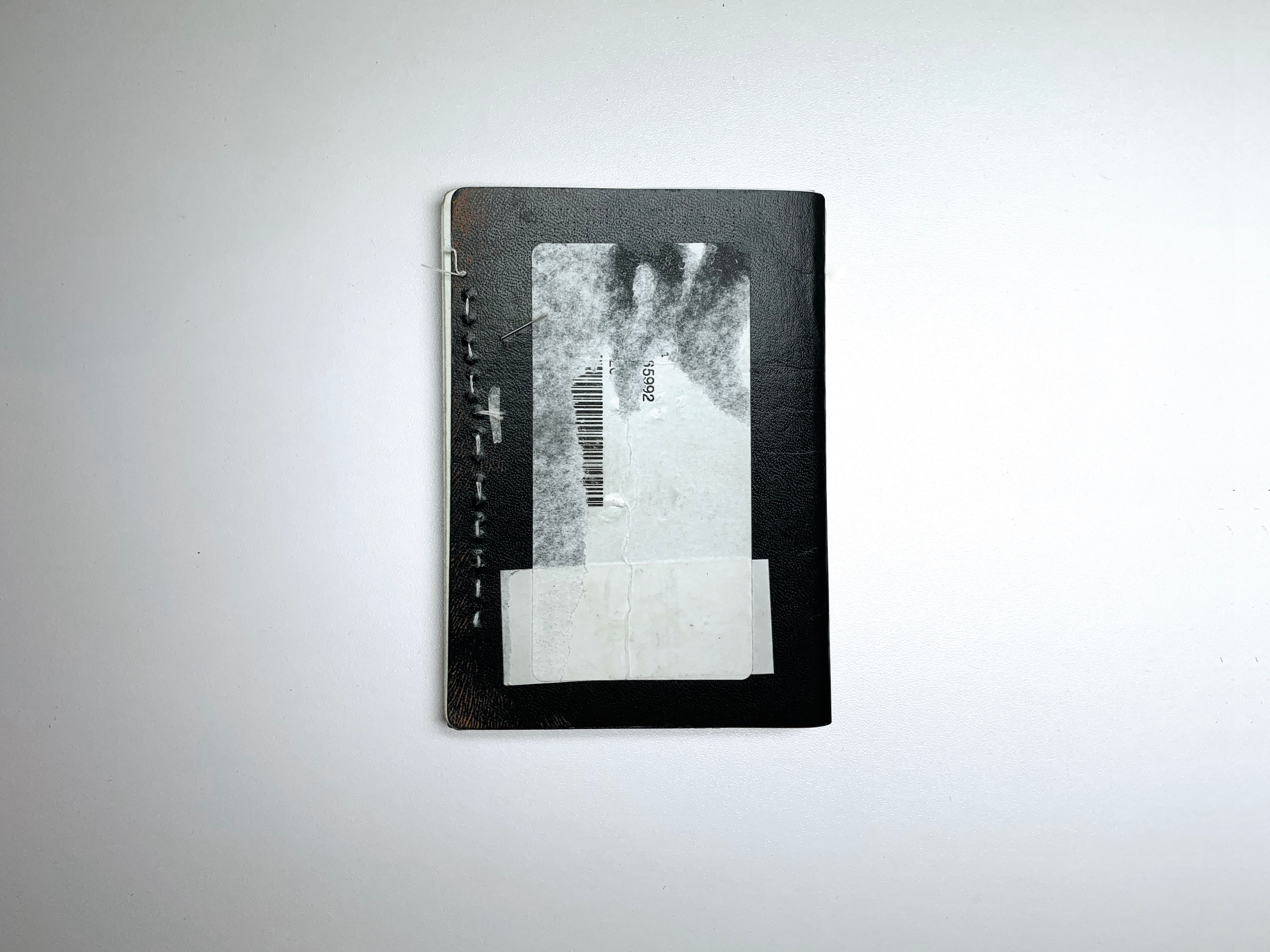
Passport

Manipulated passport and sealing wax. Barjeel Art Foundation Collection.

The binding thread was surgically removed from the passport's spine and used to sew the document permanently shut. The cover is drowned in sealing wax to redact the document’s identity.

7

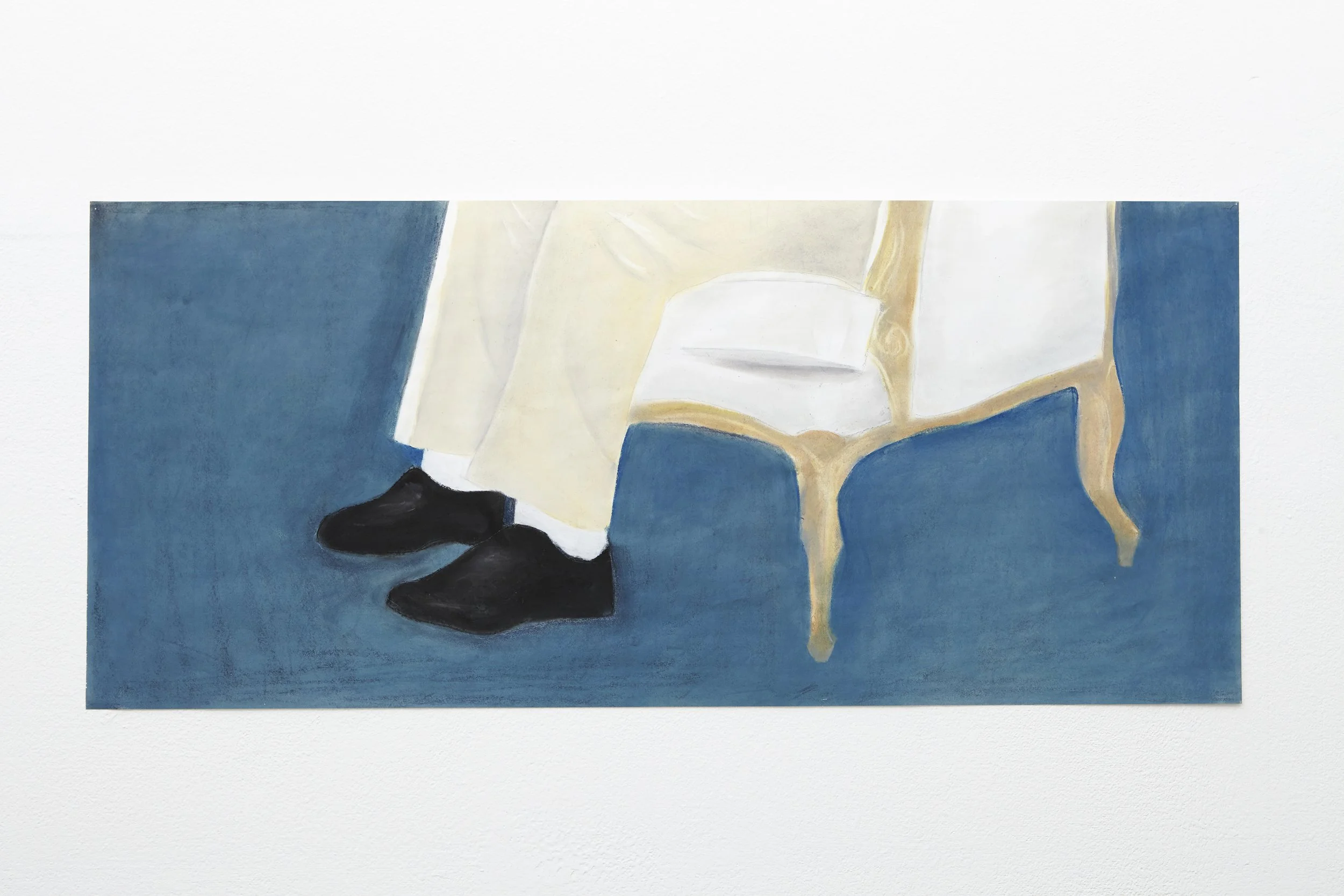
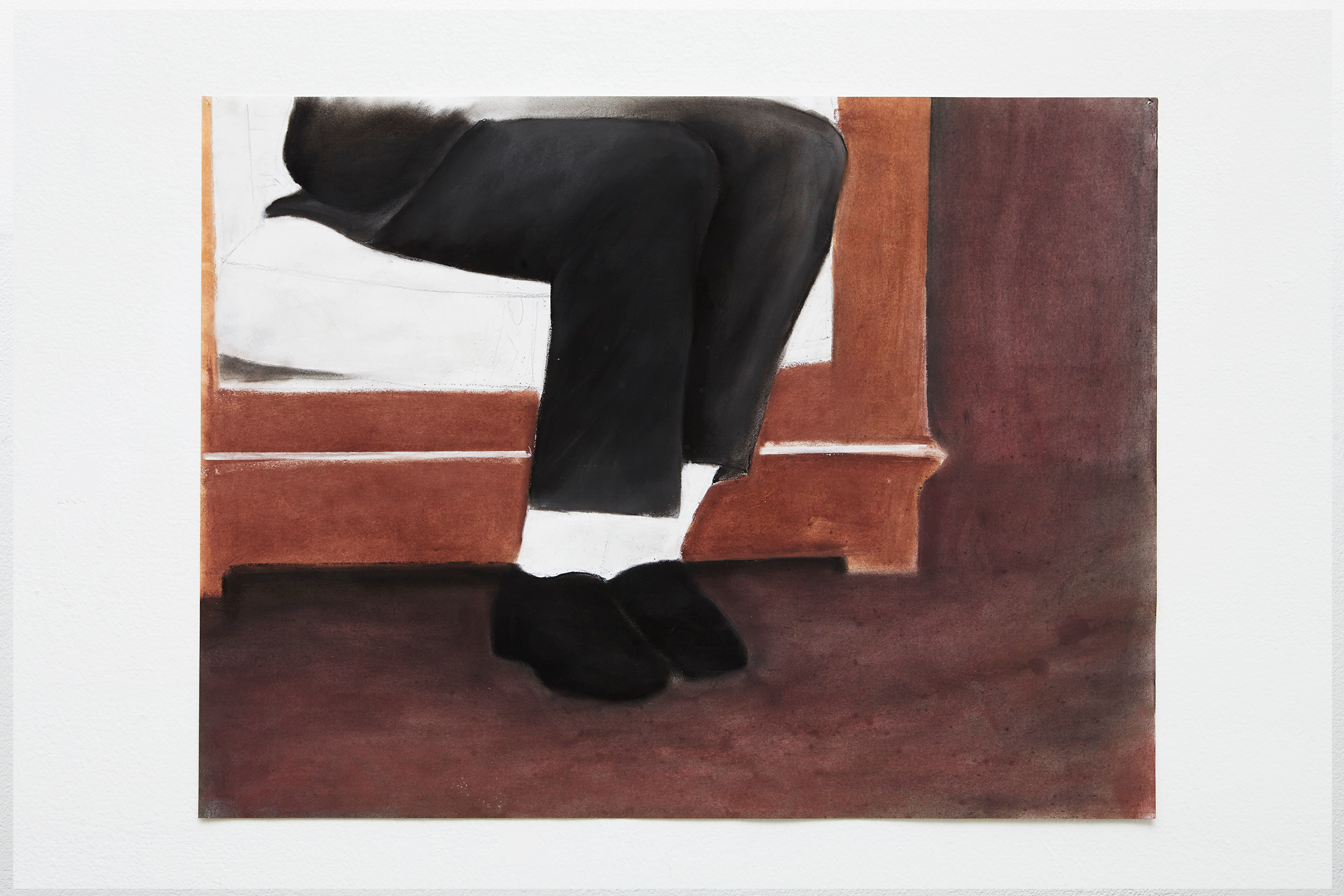
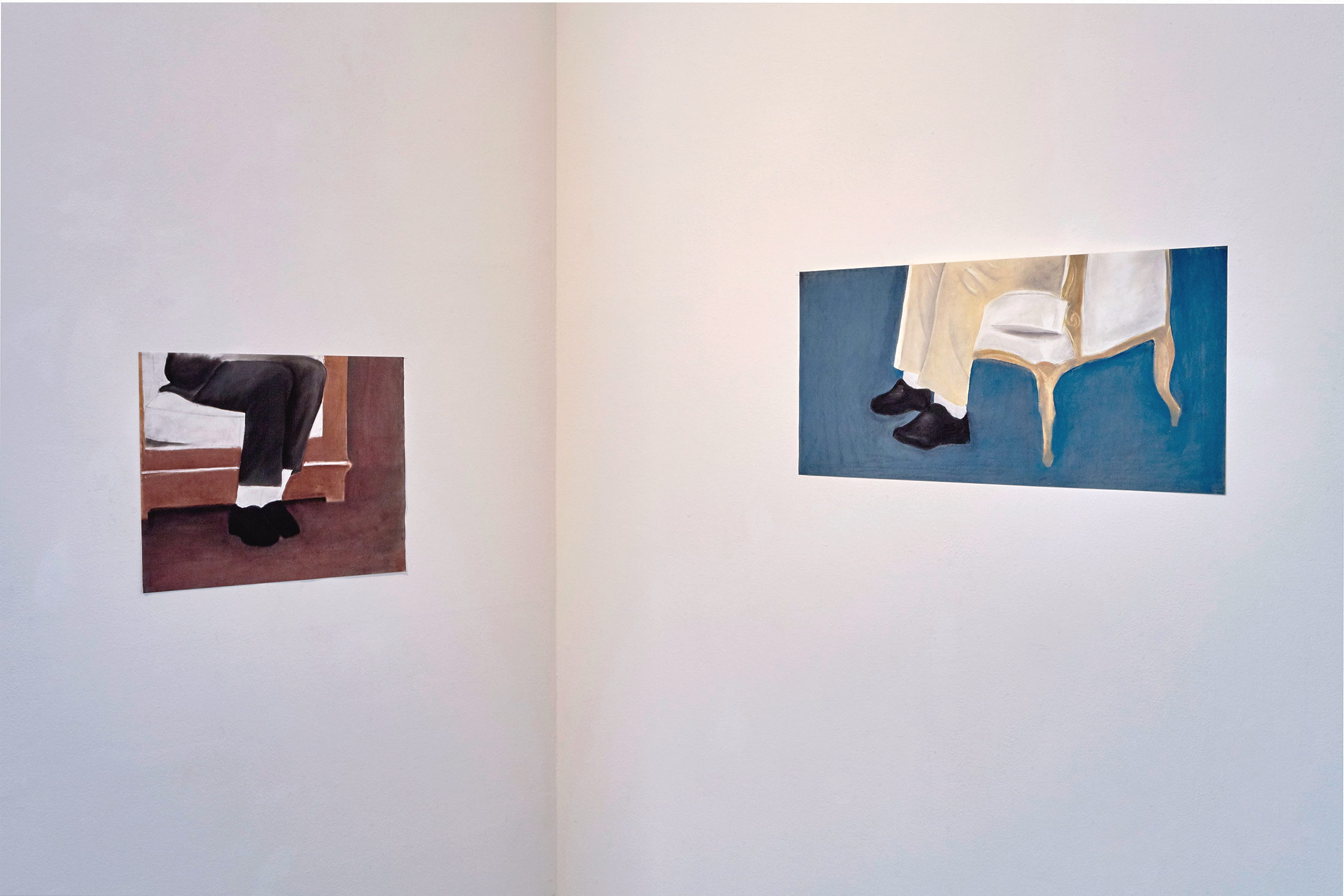
White Socks

Pastel on Paper. Series of portraits based on official press photographs. Variable dimensions.

Depicts political leaders in formal attire, disrupted by the inclusion of white athletic socks. A critique of the fragility and banality of authoritarian image-making.

8

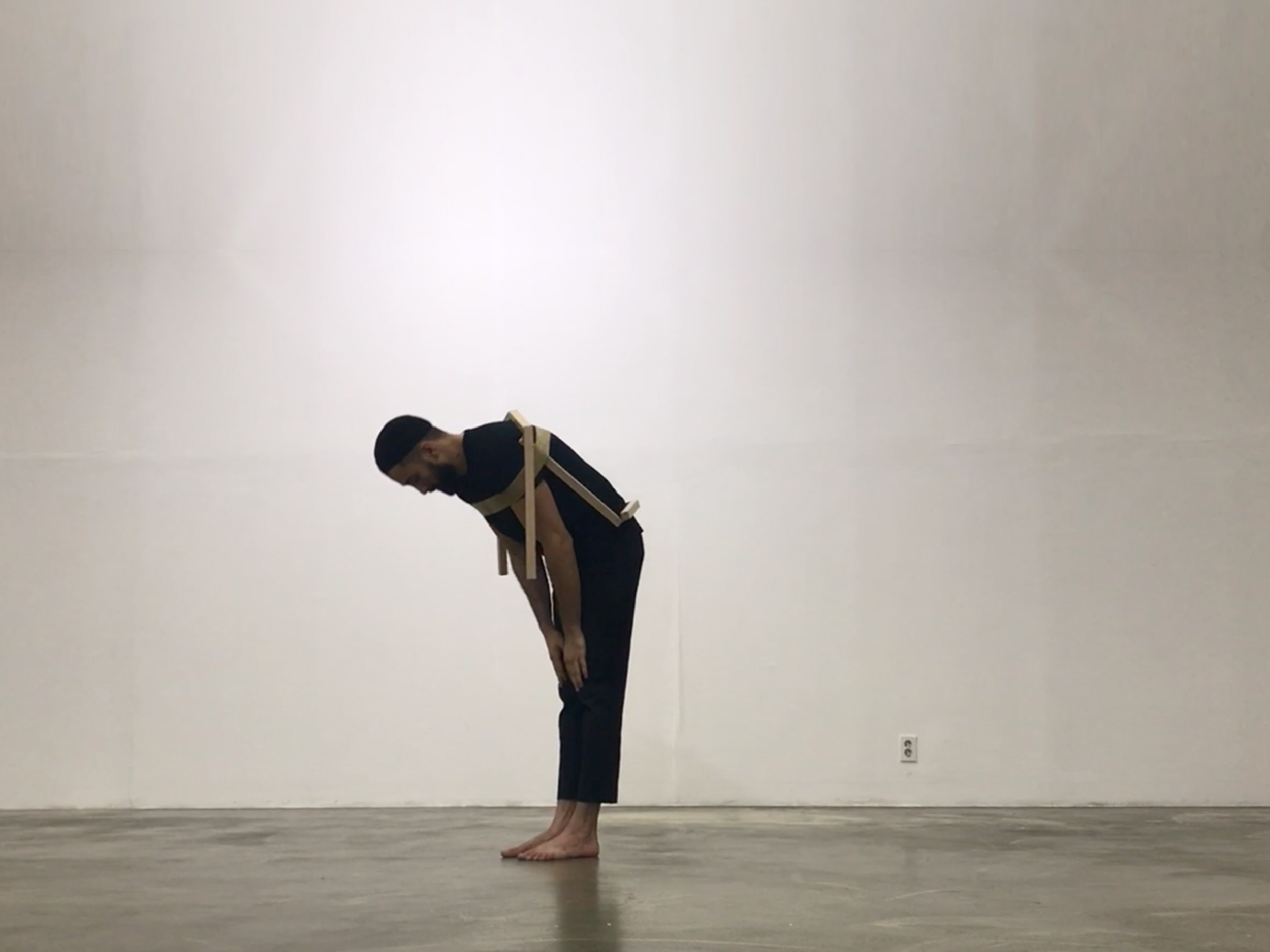
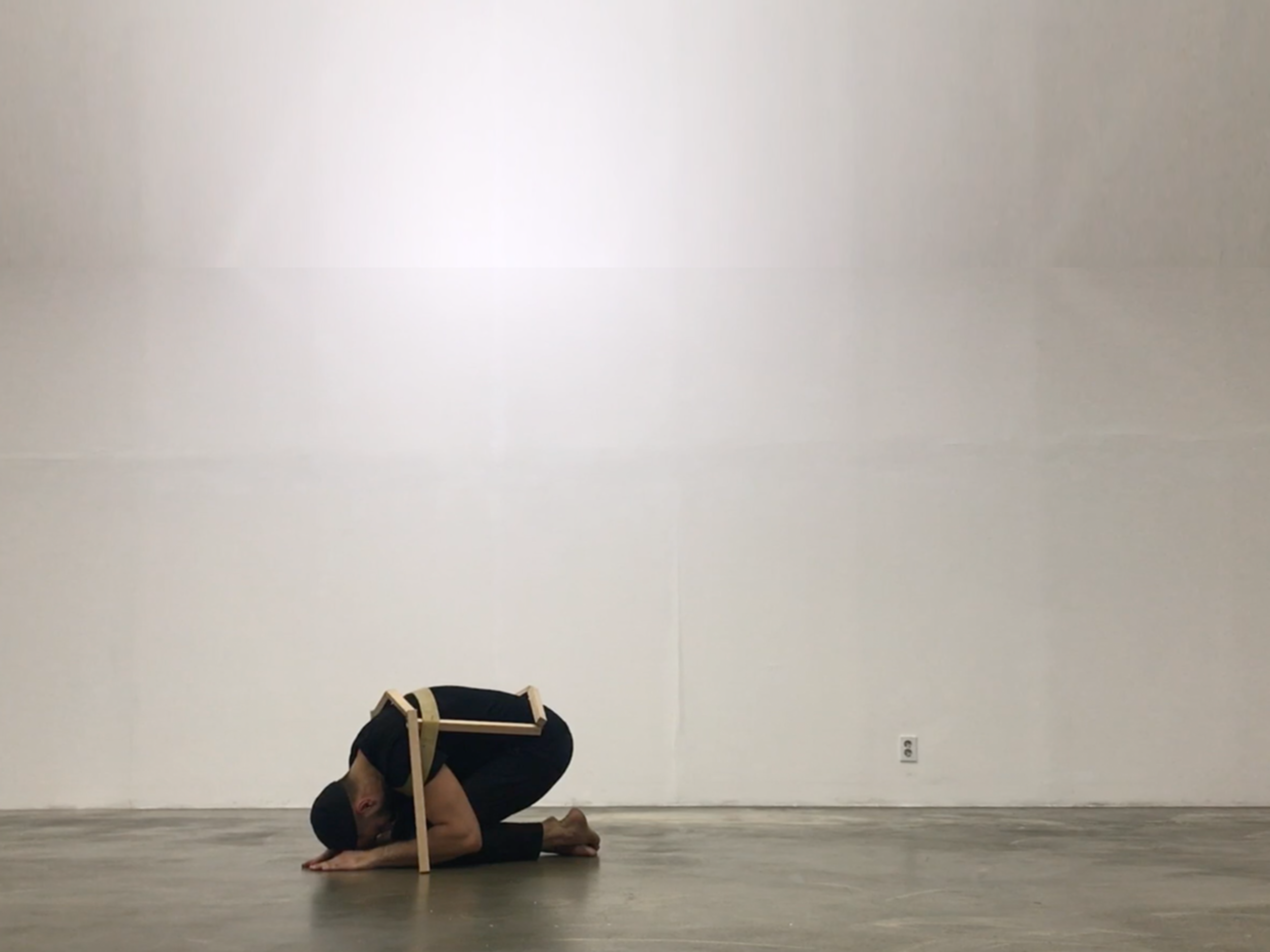
Chair Of Saladin

Wooden object and performance/video. Created under MMCA South Korea Residency Program.

A wearable wooden sculpture designed as a chair, worn by the artist while performing the Islamic 'Salah' prayer. The work physically burdens the body with the empty seat of the historical liberator, critiquing the paralysis of leadership and the weight of past glory on the present.

9

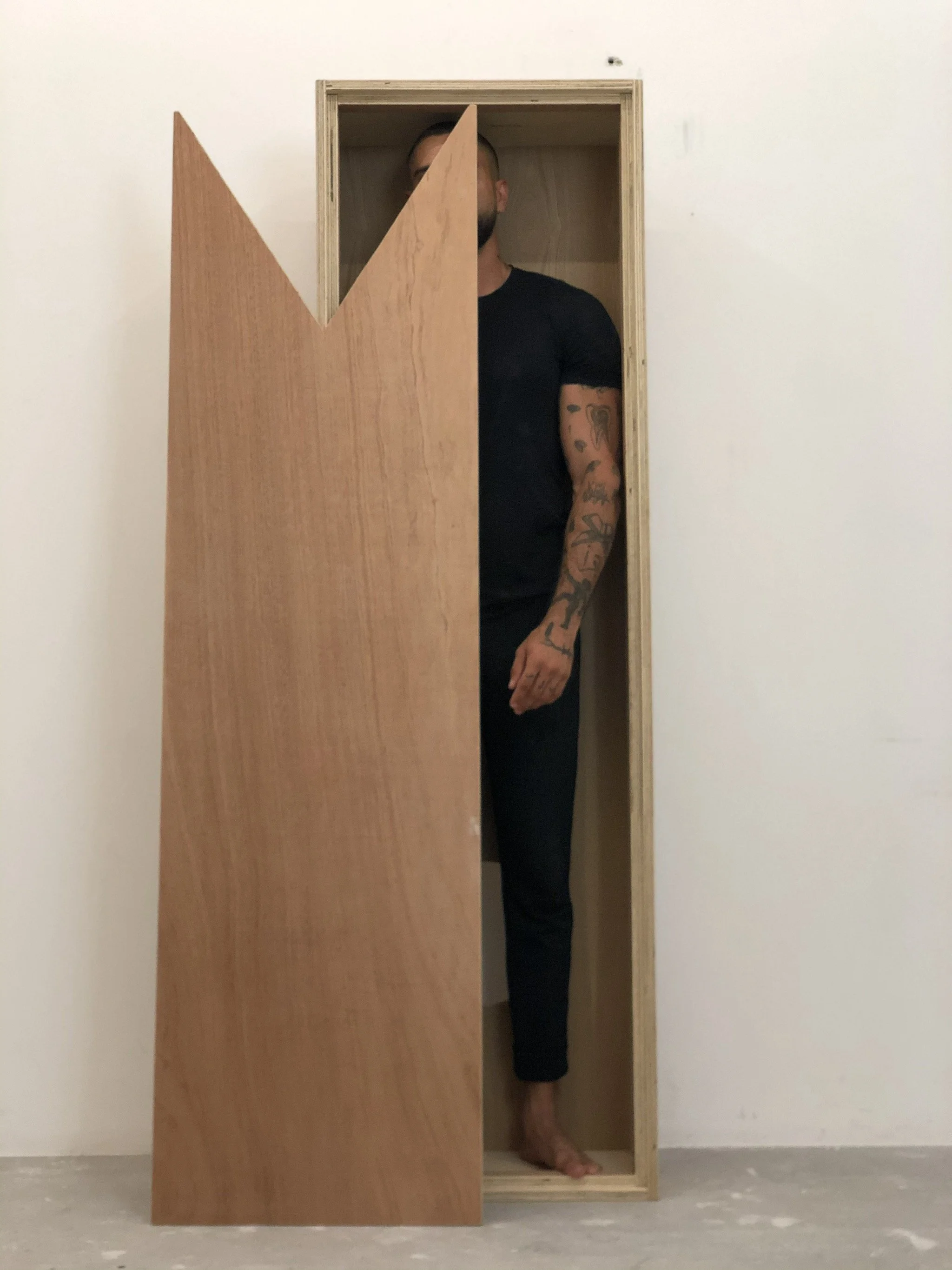
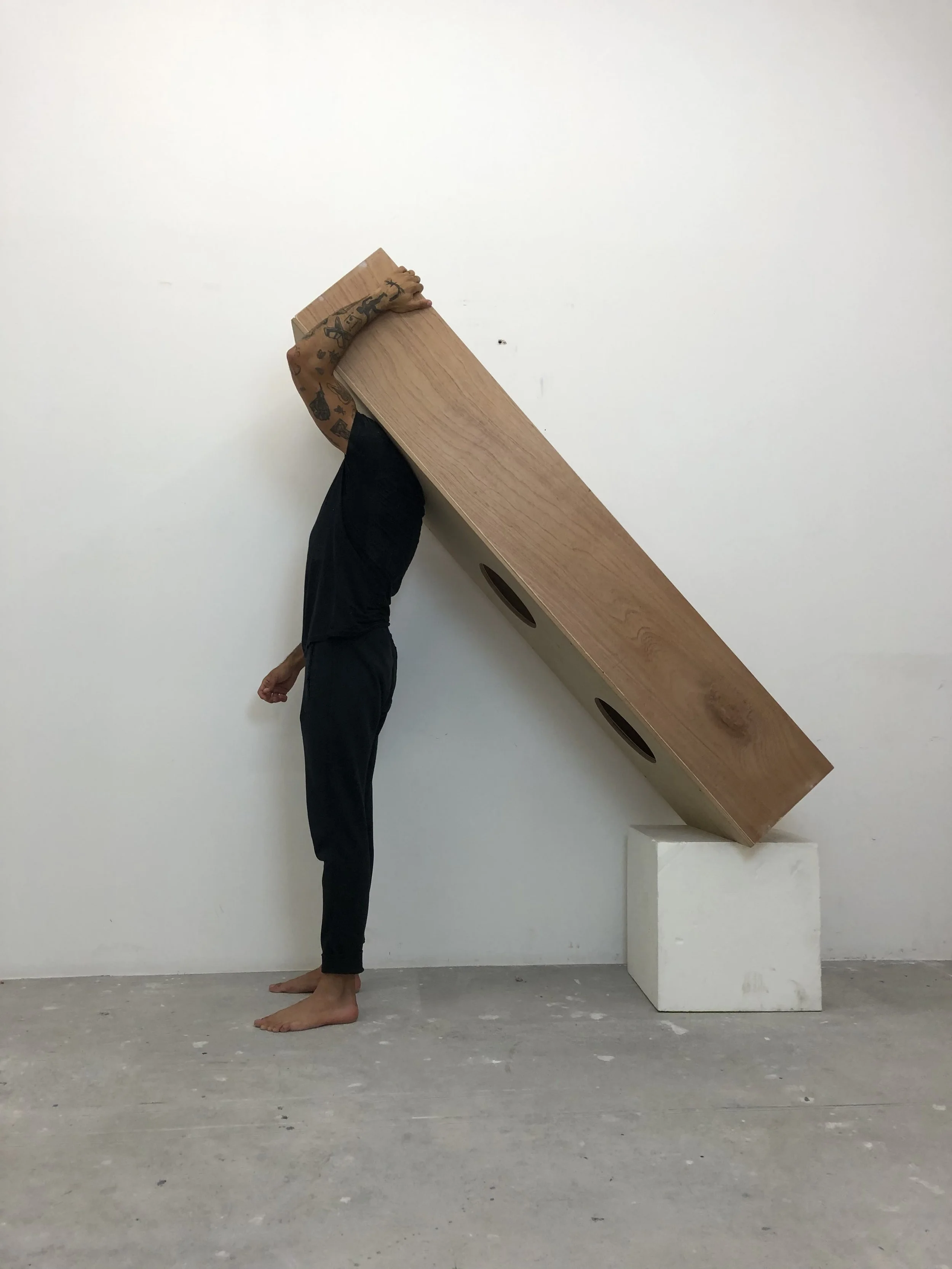
Coffin

Wooden Structure / Performance Object. Wooden coffin with a triangular front cutout and three circular bottom apertures.

Designed to be worn over the heads of the pallbearers. The carriers' heads are locked inside the box, rendering them blind to the path ahead while the public views the flag through the cutout. The work enforces a collective blindness on those who shoulder the burden of national martyrdom.

10

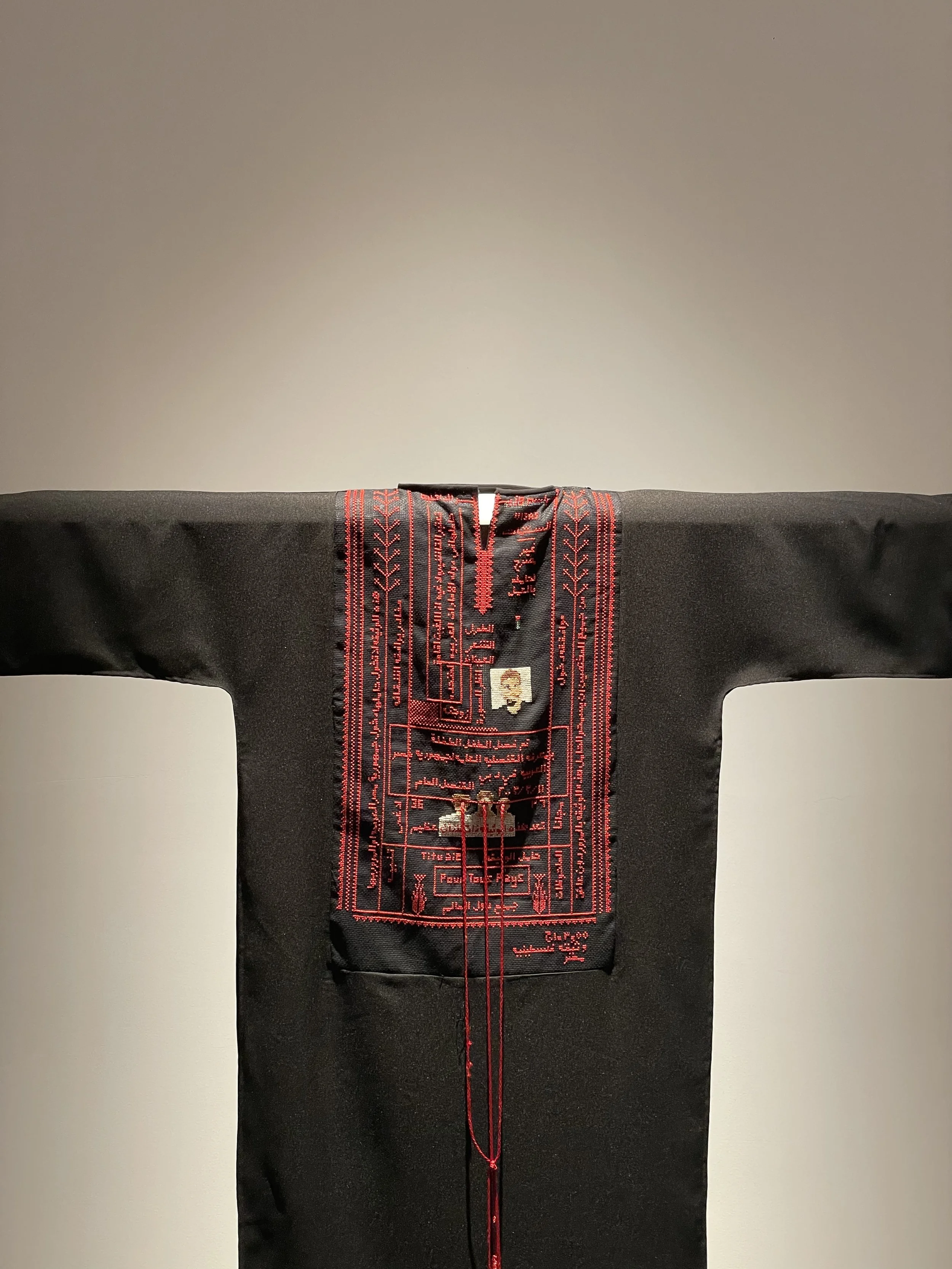
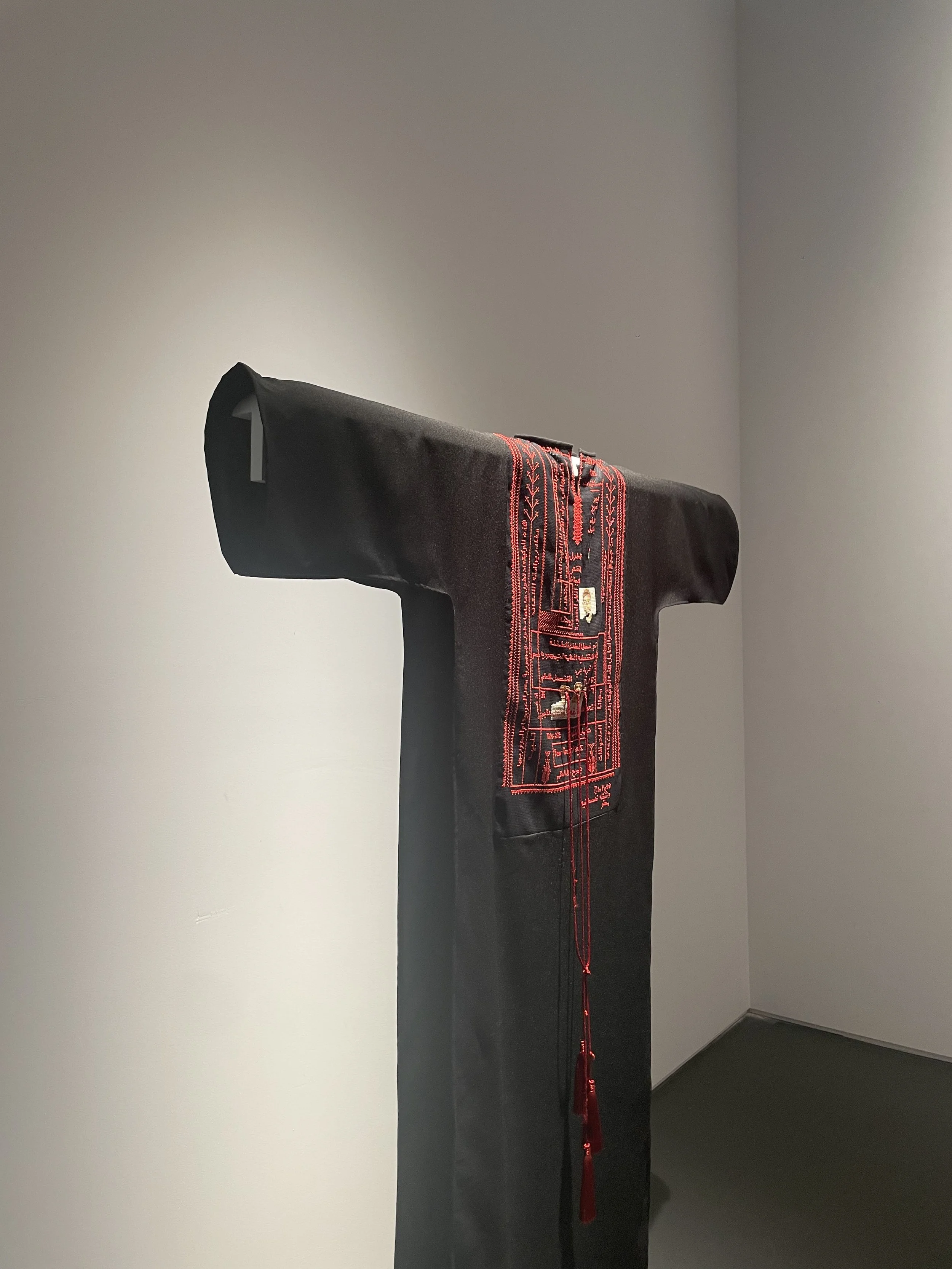
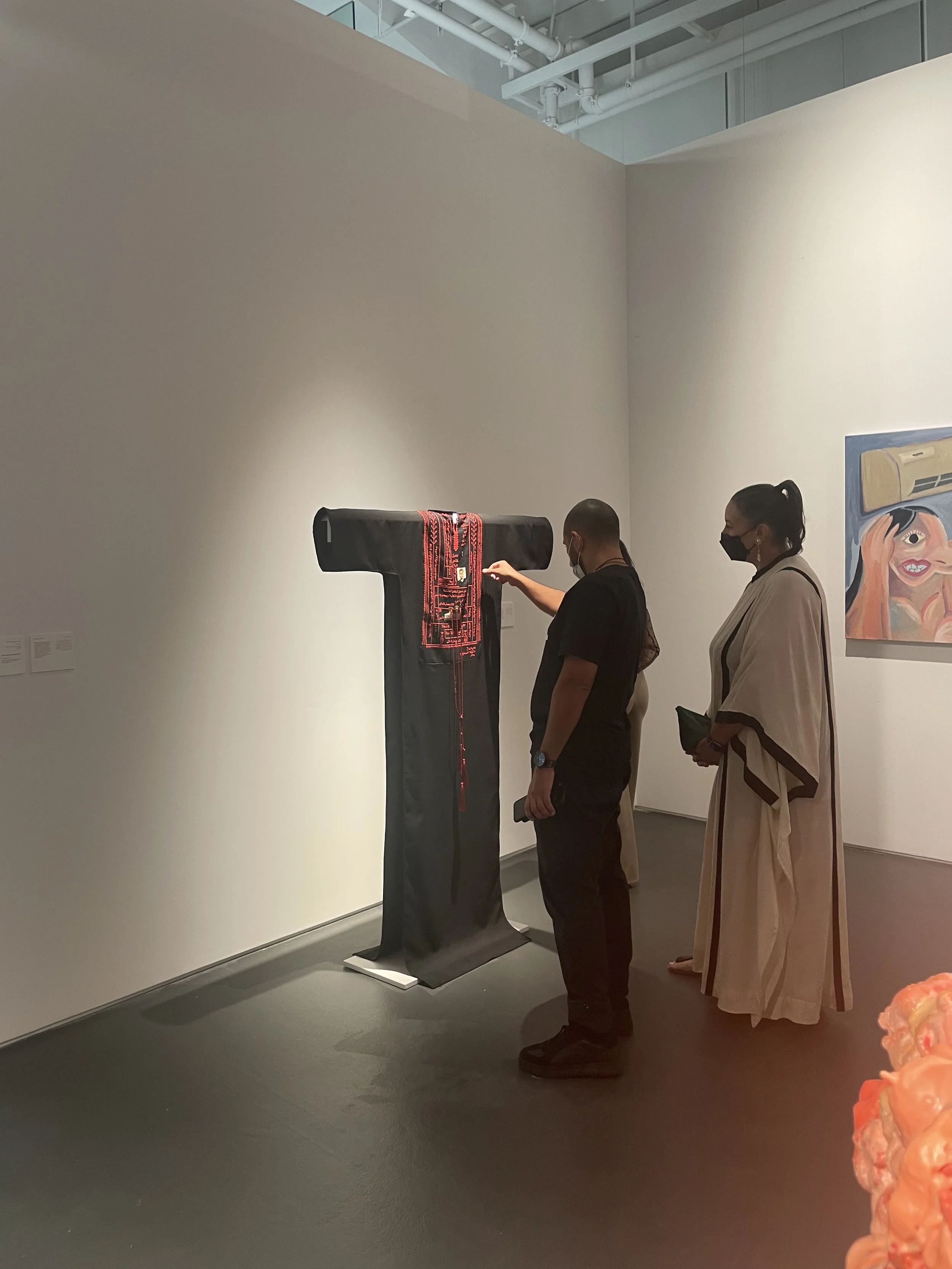
Thobe

Textile / Garment. Traditional Palestinian dress pattern.

The cross-stitch embroidery pattern is generated from high-resolution scans of a Palestinian refugee travel document. This transposition stitches the cold, bureaucratic borders of the state directly onto the warm, gendered heritage of the body.

11

Grasshopper

Performance. 40 minutes. Commissioned for FIAC.

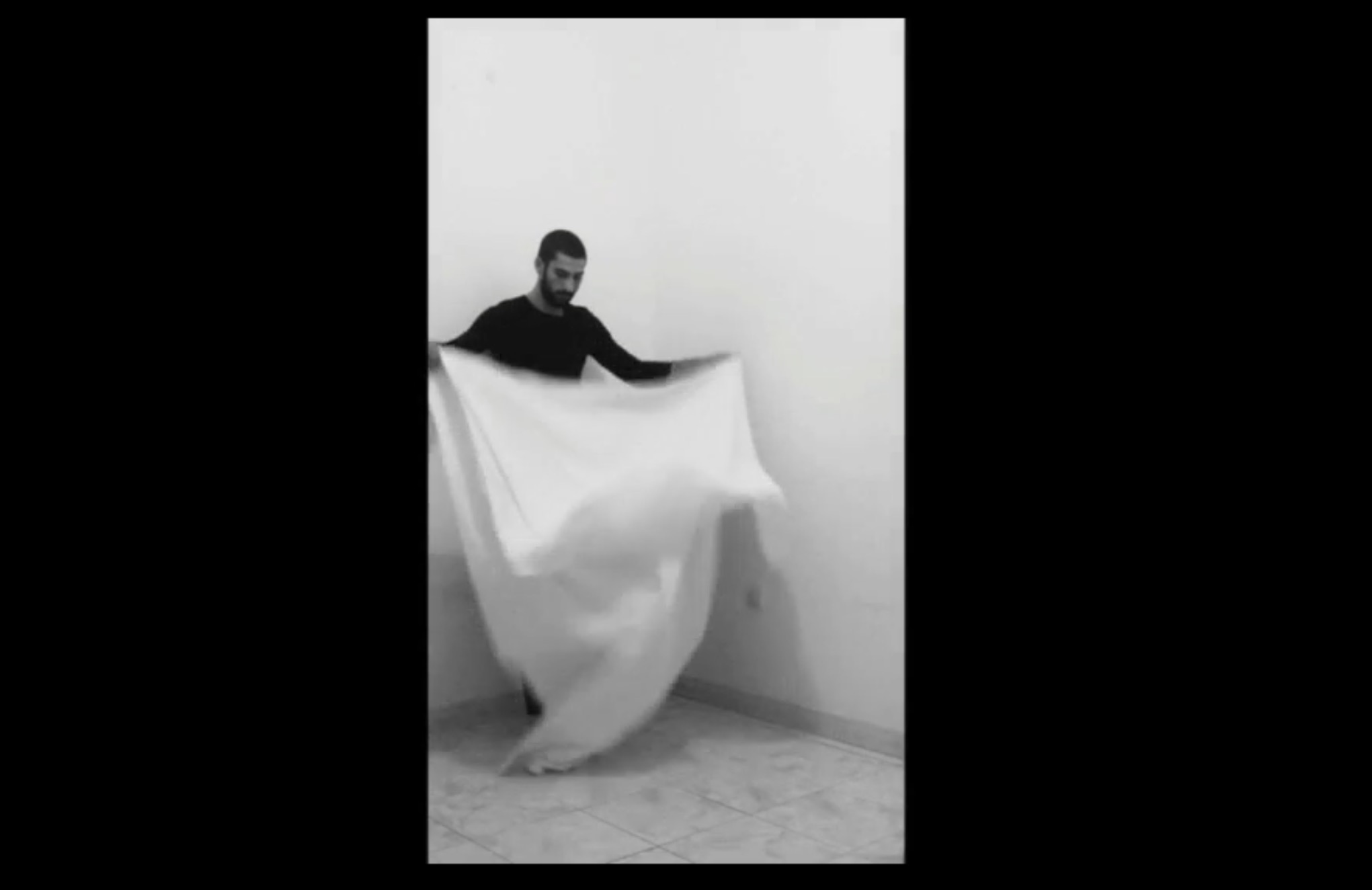
A physical enactment referencing the biological phase change of the grasshopper into the locust. The performance explores the tipping point where the solitary individual is consumed by the collective, investigating the destructive potential of the swarm.

12

Hiding

An ongoing series of mostly video works beginning in 2013 curated either as supportive material to other works or as stand alone pieces.

2017, Palestinian Handstands

2015, Chair

2013, Hiding

Biography

Walid Al Wawi is a Palestinian artist, writer, and cultural practitioner whose work moves between painting, performance, video, installation, and text. Rooted in more than a decade of engagement in the SWANA region, his practice interrogates the conditions of art in times of crisis, exposing sentimentalism as a mechanism through which institutional frameworks reduce Arab identity to tragedy.

Al Wawi’s practice unfolds at the intersection of performance, installation, and object-based intervention, where material is weaponised against the infrastructures that seek to contain it. His works dismantle the symbols through which authority, nationalism, and capital reproduce themselves. Rather than documenting identity, his practice performs its impossibility, staging Palestinian existence as both a refusal of imposed categories and an insistence on continuity beyond them.

Among his projects, EOUP (Embassy of Unofficial Palestine) proposes an architectural installation imagining a hypothetical organisation that provides relief for Palestinian refugees outside the mandates of the PLO or UNRWA. The work combines the iconography of the Dome of the Rock with the mechanics of parachuting, creating an architectural image that identifies itself as a body of aid. Through video, audio, text, and constructed form, EOUP opens an inquiry into jurisdiction, exile, and the possibilities of unofficial spaces.

Al Wawi has been welcomed by institutions including Darat al Funun, Jameel Arts Centre, Tate Exchange, the Museum of Modern and Contemporary Art South Korea, and FIAC Art Fair, though his work insists on the limits of such spaces.

Building on this trajectory, in 2017 Al Wawi founded Samt, a virtual platform for art and research that exists primarily online through samt.co. Conceived as both a critique and an alternative to the Western-centered art educational canon, Samt challenges the political economy and hierarchical structures of the art system. By shifting the site of discourse from fixed geographies to a fluid techno-digital approach, it expands the terrain of art beyond its physical confinements.

In 2022, Samt advanced this mission with the creation of the Samt Alternative Art School (SAAS), directly confronting the Eurocentric academy, capitalist frameworks, and patriarchal dominance embedded in the historical and contemporary art canon, fostering instead a pedagogy of insurgent practice.

Resume

Residencies

  • 2017Museum of Modern and Contemporary Art, Seoul

Exhibitions, Fairs & International contributions

  • 2022Verbal History, Public Art Fund, New York
  • 2022He-athen, Mathaf, Qatar
  • 2019EOUP, Art Jameel, Dubai
  • 2019Qala, Darat Al Funun, Amman
  • 2018We Shall Be Monsters, Qattan Art Foundation, Ramallah
  • 2017May God Teach You English, MMCA, Seoul
  • 2017The Rationaliser .b, XX Bienal, Santa Cruz
  • 2017Dialectic, Tate Exchange, London
  • 2017Portrait Patriot, Momentum, Berlin
  • 2016Flood System, Art16, London
  • 2016Iteration, Satalite, Dubai
  • 2016The Rationaliser, Fe Alharaka Baraka, Maraya Art Center, Dubai
  • 2014The Grasshopper, FIAC In Process, Paris
  • 2014Modification and tragedy, Turning point, Tashkeel, Dubai
  • 2013Hiding, INCUBARTE, Spain
  • 2013Flood System, Maraya Art Center, Abudhabi Art, Dubai
  • 2012Place the dots, Funoon, Art Dubai, Dubai

Curation

  • Qala 0.89003 at Darat Al Funun, The Lab
  • Qala 0.89002 at Gray Noise, Alserkal Avenue
  • Qala 0.89001 at Satellite, Alserkal Avenue
  • Flag Continent at TATE exchange

Awards & Honours

  • 201810 Finalists, YAYA 2018, Qattan Art Foundation
  • 2017Slama Art Fellowship
  • 201650 Finalists, Sovereign Art Prize
  • 2013Kunooz Art Prize, Ayyam Gallery
  • 201350 Shortlisted, Emergant International Artist
  • 2011First Place in Fine Arts, Shikha Manal YAA

Collections

  • 2020Burjeel Art Foundation
  • 2016Zayed Bin Sultan Al Nahyan
  • 2016Maraya Art Center
1

How To Deseed A Watermelon For Safe Consumption

2018, Gaza

Thousands gather, pressing against the border fence in what was called The Great March of Return. Across from them stand Israeli soldiers, framed by the alien architecture of metal and concrete. Rifles raised, they fire directly into the crowd. Men, women, and children struck down beneath the colors of red, black, white, and green stretched across wood. A simple piece of fabric becomes a target.

Soldiers with rifles; marchers with flags. One fires bullets, the other eclipses erasure by waving above the heads of empire. The Palestinian flag is lethal not for what it can do, but for what it declares: presence, permanence, and the insignificance of the occupier’s power in the face of a people’s pride.

Beyond Palestine, however, another image has taken hold among those estranged from the land. A watermelon split open, its red flesh and green rind echoing the flag. On tote bags, murals, and gallery merchandise, it circulates freely as shorthand for solidarity.

But how did a symbol that claims to empower the prohibited come to eclipse it? The answer lies not in the curated gallery walls or carefully written statements at public events, but in another watermelon, one carried by a mother in Haifa in the early 1970s.

1972, Haifa

A Palestinian woman moves through the machinery of occupation. Her presence appears unremarkable: in one arm she steadies her infant son, in the other she carries a basket of fruit. A mother, slow, vulnerable. Her name was Zakia Shamut, known as “Umm Mas’oud,” and in her basket lay a hollowed watermelon. Poor in nutrition but heavy in substance, its flesh had been replaced with twenty kilograms of explosives.

The watermelon she carried that day was placed in the occupied city of Haifa, detonating in a Bulgarian circus and killing fifteen Israelis, wounding dozens more.

In that moment, the colonial logic of domination was undone. A mother and her fruit basket brought the very infrastructure of regulation into collapse. Not by force alone, but by confronting the gaze of empire and exploiting how it sees, and refuses to see, the Palestinian body.

Within the fragile order

Within the fragile order of the settler colony and its obsession with preserving a façade of permanence, the native body must be rendered transparent and categorically contained within paranoid taxonomies that sustain the colony’s fabricated hierarchy. The colony must therefore multiply its eyes and extend its reach; its surveillance is not confined to official channels but diffused throughout the social fabric of its alien population. Embedded in the gaze of men, women, and children, each settler is a deputized agent of observation.

Under such an order, the Palestinian mother unfolds a paradox. Beyond the present, her body torments the colonial calculus of demographics; her fertility provokes existential alarm that haunts the settler’s projections of permanence. Yet in the immediate encounter, she is presumed harmless, her maternal role overriding suspicion, her nurturing urges classifying her as noncombatant.

By understanding this contradiction, Umm Mas’oud converts decades of routine scrutiny into tactical cover. Under the guise of a mother carrying an overbearingly heavy summer fruit, she penetrates the colony’s surveillance, generating an innocent opacity the empire’s logic fails to penetrate.

But Zakia’s watermelon was never neutral. She didn’t carry it to disguise her way into safety but to pierce and rupture. Its danger lay in its ephemerality past its objective, refusing to overshadow its purpose of turning the occupier’s violence against itself, by weaponising invisibility, and making survival itself ungovernable.

In stark contrast to the watermelon that circulates today, while its use may have been argued to serve a purpose under clear and specific circumstances, its usefulness can easily be deemed detrimental to its cause if such circumstances are not present, turning the conveniently coloured fruit into exactly that: convenience that never endangers its carrier.

The bourgeois order tolerates, even embraces, symbols that leave its machinery intact. Worn on tote bags and distributed on event brochures, the symbol of the watermelon is turned into a harmless emblem of identity. Its safety is precisely its condition of possibility. It punctures nothing; it risks nothing. It thrives because it can be consumed, replicated, and displayed without consequence.

A lazy and cowardly infantilization of the Palestinian struggle sold as radical ingenuity, designed to satisfy performative dissent yet survive within empire’s optics.

But to resist erasure is not to invent new ways of existing safely within empire’s prohibitions; it is to confront the machinery that enforces it, its bans, its surveillance, its carceral architectures. When the Palestinian flag draws bullets in Gaza and arrests in Jerusalem, replacing it with another symbol in other parts of the world does not preserve solidarity; it concedes to domination and renders it palatable for liberal frameworks that refuse the story of Zakia: that a Palestinian can be a fighter as well as a victim.

Born in Haifa

Born in Haifa in 1945, Zakia Shamut was one of the first Palestinian women in the ’48 territories to join the armed resistance. By the early 1970s she had carried out seven operations against settlers and soldiers alike. For years she eluded capture, only later arrested mid-pregnancy along with her family and sentenced by an Israeli military court to 1,188 years in prison.

Zakia’s story exposes the violence of symbolism. It confronts the boundaries between symbol and substance, between décor and intervention. It rejects the safe theatre of resistance that never punctures colonial control. It reminds us that symbols retain their force only when they rupture empire’s machinery, not when they circulate safely within it.

Her watermelon teaches us that militant improvisation must remain undomesticated. Resistance can only become heritage if it achieves its goal of complete liberation; otherwise, its embrace is simply domestication into institutional order.
2

Militant Improvisation: The Militant Cultural Front

In moments of profound crisis, the limitations of form become impossible to ignore. The act of depiction collapses under the weight of necessity, and the canonical tools used to represent suffering, injustice, or resistance within cultural production reveal their theatrical inadequacy in the face of material urgency.

Creative language, as inherited through dominant institutions, is already disarmed. It has been neutralized through repetition, commodified through circulation, and contained through institutional framing. Even the most violent realities are metabolised into spectacle where suffering becomes content and resistance is theme.

Art, when assimilated into this cycle, becomes soft décor for hard power, a symbolic currency within elite cultural economies, where it is asked to heal, to reconcile, to soothe. But what if healing, within this dynamic, is itself a trap? What if the invitation to “process” trauma is merely a detour, a return to a world that must be refused?

Militant improvisation emerges precisely at this point of refusal, through which it performs an entirely different function. It is tactically operational before it is metaphorical or symbolic, driven first and foremost by urgency: the urgency of the moment (the temporal) and the urgency of clarity (the contextual).

1. Temporal

Art produced within institutional frameworks often fetishizes immortality and manufactures relevance. It is nurtured by the luxury of time, slow reflection, delayed interpretation. It validates itself through processes of curation, contextualization, and critical analysis. It waits for reviews, and participates in cycles of exhibition and critique. By the time it arrives, the world it responds to no longer exists.

Improvisation becomes a necessity when the structures meant to preserve life are the same ones dismantling it.

Militant improvisation refuses delay. It is born into emergency, through the very womb of crisis. It understands that its urgency renders it ephemeral, sometimes by choice, but more often by force. In response, it improvises itself for immediate impact, with no formal attachments. It is not crafted for permanence, nor intended for the archive.

2. Contextual

Militant improvisation does not require philosophical intricacy or theoretical complexity. It is not formulated to be seen only through squinting eyes. It is vivid and instantly legible, rejecting interpretive buffers and conceptual padding. It speaks to those already in motion, those without the luxury of a still moment to fill up with silence. If it cannot be understood immediately, it has already failed to act.

In fact, one might not always recognize the categorical form of the improvised on sight, as it is not meant to be measured by institutional metrics. Militant improvisation may appear alien to the linguistics of art discourse, not because it is too abstract, but because it rejects the frameworks that render art palatable and profitable. It manifests as gestures that resist authorship, unconcerned with legacy or polish.

Crucially, militant improvisation must not be confused with “Radical Art” as defined by galleries or academic discourse. It is not a provocateur in form yet conformist in function. It is not about illustrating slogans or echoing movements from a safe distance. It is grounded in non-metaphorical violence, not in shocking the spectator, but in sustaining revolutionary continuity.

Militant improvisation cannot be disciplined into institutional logic, where visibility is often weaponised and “militancy” becomes a strategy performed within the sanctioned violence of art spaces.

Likewise, militant improvisation does not refer to “militant aesthetics,” because insurgency has no aesthetic, and crisis follows no formal logic. It is not defined by style, and its aesthetics are not a choice. It is not “art activism” in the liberal tradition, nor a strategic disruption of bourgeois spaces for symbolic effect. Instead it is carved in struggle and indistinguishable from survival.

Improvisation allows movement in shadows, avoiding the traps of co-optation and spectacle. By refusing to ask for entry, it appears uninvited, knowing that inclusion is not solidarity, but the final act of neutralisation.

***

Though militant improvisation rejects the conventions of art as an institution, it enters this discourse not because it desires to belong, but because it is continually pursued and appropriated by it. Its methods, born of urgency and refusal, are inherently creative acts of insurgent making.

What forces it into overlap with the artistic paradigm is not a shared ethos, but the historical tendency of bourgeois artists and academics to hijack revolutionary gestures, extracting form while discarding function.

Thus, militant improvisation appears here not as art, but as a contested zone where art’s complicity, appropriation, and limits are exposed.

3

The Many And The Ones

As we try to advocate for the voices on Palestine to remain within the principles of true liberation, we find ourselves framed as inflammatory, divisive, hateful, or even purist.

While no one is surprised at such reactions, geared towards protecting the comfort of the many by demonising any hard calls for true change that may challenge their comfort, we must still ponder on what it unmasks of their character.
The many are not accustomed to caring for extended periods about things that they don’t perceive as a direct threat to their capital, leading them to ‘virtue fatigue,’ where engagement in social causes can wane when individuals feel overwhelmed or when the cause does not directly impact them.

The many want things to go back to ‘normal,’ or at least for things to slow down enough for them to resettle into their class privilege. And for that to happen, they must find a win; they must celebrate a victory, but not just any victory. It must be one that doesn’t disrupt their dinner parties and easily melts on the velvet tongues of their ruling class, irrelevant if it actually resolves the material reality of the genocide.

The many are finding it terrifying to realise that the system does not work for them; they are finding it humiliating knowing everyone knows they are not special in a system that holds capital over man. They want to maintain their narcissistic illusion of influence, as if they have control, as if they matter.
To The Grifters, Fame Farmers, Unprincipled, and Willingly Blind, the ones speaking of their land as if it were a landmine, folding and twisting their tongues to avoid the trigger words planted by its colonisers, afraid they might swallow their tongues and choke if they were ever unfolded.

The ones that cried free Palestine, until they realised freeing Palestine challenges the survival of the imperialist framework from which they reap their privileges.

The ones that exploit the slogans of change and radical freedom to maintain the relevance of their clout capital, all while gatekeeping a system that benefits them at the expense of others.

The ones so addicted to comfort that they marry hypocrisy to authenticity in the name of convenience, fighting the oppressors’ tanks with hashtags because a bullet shot at the oppressed registers more quietly in their news media than one shot by the oppressed.

Freeing Palestine will free the world, they say, but does the world really want to be free?

To the many and the ones, we are not invested in your support if it’s rooted within the system, one that sexualises revolutions and commodifies sex, one that capitalises on freedom by restricting capital, one that promises liberty only within the confines of its ‘moral prison’.

To the many and the ones, we are not invested in your comfort, so unfold your tongue, if you swallow it and choke, at least you’ve died a martyr.

4

South, North, Palestine

If your understanding of the Palestinian struggle is examined through the South African lens rather than the Algerian struggle, your solidarity is detrimental as it plays into the imperialist trap.

It is with no doubt that the struggles of the Algerians and South Africans continue to inspire the oppressed across the globe.

That said, when correlating them to Palestine, the comparison must be based on a comprehensive analysis of each liberation movement's geopolitical and historical dimensions and its contemporary manifestation into material reality.

1. Geopolitics and the imperialist crawler:

While we may draw parallels with South Africa for a more precise grasp of Zionism's oppressive implementation of apartheid, we must not fall into the liberal fantasy of using it as the primary point of reference to understanding Palestinian liberation.

Such restricted analysis oversimplifies the Palestinian narrative into an internal conflict between native and settler, a deliberate misdirection towards blind mobilisation against visible symptoms, such as apartheid, to shield the hungry imperialist beast lurking on the outskirts, relieving him from the shame of hearing his growling stomach and the alien tongue of his settler agents.

Therefore, a closer examination of the regional alignment between Algeria and Palestine, as well as their historical, religious and linguistic connections, can help us better understand the uncontrollable nature of colonial violence, its supremacist entitlement and exploitative survivalism, which resides beyond justification and ethical dialogue.

Ignoring the critical Algerian analogy is a reductionist tactic that not only derails efforts to address the alien nature of the Zionist oppressor but deliberately downplays the native's right to armed resistance against the infiltrating settlers and their role in the colonial body.

2. Settlers and letting the dust settle:

While South Africa's decision to negotiate and reconcile with settlers was pivotal for their movement, its focus on primarily tackling the discriminatory system of apartheid left the colonial exploitative structures largely intact.

  • The integration of the settler class made it close to impossible to rectify wealth imbalances where land distribution patterns favouring the white minority persisted.
  • The corporate sector that supported the apartheid regime maintained its influence post-transition.
  • Educational opportunities remained unequal, reinforcing historical imbalances which contributed to social stratification along racial lines.

In contrast, Algeria's uncompromising position on the complete dismantling of settler colonialism and unapologetic recognition of settlers as the colony’s infiltrating tentacles that must be severed, played a crucial role in the complete dismantling of exploitative structures.

  • Ending neo-colonial dependencies and ensuring genuine sovereignty for the indigenous.
  • Ensuring a definitive break from the colonial past, fostering national pride and unity, minimising internal tensions and contributing to a cohesive post-independence society.
  • Facilitating economic redistribution addressing historical injustices for a more egalitarian society.

Understanding the alignment of Algeria and Palestine in both geopolitical relevance to the imperial core and shared mission towards absolute liberation from the colonial beast, his exploitative dimensions, and illegitimate offspring is imperative to interpreting the core predicament of the Palestinian struggle – one that is centred on the complete extermination of the external occupation, not, as seen in the case of South Africa's apartheid, a systematic dismantling of an internal discriminatory system by negotiating the oppressor into validity.

The Algerian experience teaches us that diplomatic solutions may result in tragic outcomes, that true freedom is seized, not granted, and that legal reforms may inadvertently harm the oppressed. In times of extreme violence, nuanced politics and humanism often face limitations, emphasising the difficulty of reconciling conflicting perspectives amid violent struggles where true freedom can only be taken by force rather than granted through negotiations.

In conclusion

In conclusion, the dangers associated with neglecting the deeper perspective provided by the Algerian comparison are manifold. Focusing on South Africa poses risks of oversimplification and misinterpretation of the root cause of oppression.

Recognising these dangers is paramount to fostering a comprehensive and informed solidarity with the Palestinian struggle for justice and self-determination.

5

“Israel’s” Co-Opting Of Indigenous Struggle.

Any discussion of Indigeneity regarding a group of people must delve into colonialism, particularly settler colonialism.

1. What Is Indigeneity?

In a broader scientific context, the term "Indigeneity" or "Indigenous" refers to the origin of a species or organism from a specific location. However, when referring to a people in the context of human rights and international law, "Indigenous" refers to the original inhabitants of a particular region who have lived there for generations before the arrival of colonial settlers from another country.

The immigrants view the natives as detrimental to the colony; therefore, they dispossess them of their lands, resources, and cultural heritage and marginalise or suppress their rights and identities. In 2007, The UN formally recognised the rights of indigenous peoples by adopting the United Nations Declaration on the Rights of Indigenous Peoples (UNDRIP).

The working definition of "Indigenous Peoples":

"…those communities, peoples and nations who, having a 1.historical continuity with pre-colonial and/or pre-settler societies that developed on their territories, consider themselves 2.distinct from other sectors of the societies now prevailing in those territories, or parts of them. They 3.form at present non-dominant sectors of society and are 4.determined to preserve, develop and transmit to future generations their ancestral territories, and their ethnic identity, as the basis of their continued existence as peoples…”

Example of indigenous people:

  • First Nations, Inuit and Métis in Canada
  • Aboriginal and Torres Strait Islander people in Australia

A group is not referred to as indigenous if they are not within or have not experienced a colonial power structure, even if they practically originate from their current locality, for example:

  • Frankish People in France
  • Anglo-Saxon Englishmen in the British Isles
  • Dutch, Italians, Germans.

In fact, Indigenous groups may cease to be referred to as indigenous if their colonial relation is dismantled. Thus, to identify the Indigenous we must identify the coloniser as the two are often closely intertwined.

2. Israel, A Proud Colonial State.

Historically, colonial expansion was a source of European pride, with no understanding of Indigeneity as a right to land but as a negative status indicating savagery and backwardness.

Political Zionism, a movement that emerged in late 19th century Europe, was heavily influenced by colonial ideologies of the time, a fact that is well-documented in the writings of Zionist thinkers and politicians, including Theodor Herzl, regarded as the "Father of Modern Zionism." In his quest for support and recognition, Herzl sought alliances with colonial powers such as France and the United Kingdom and other settler colonial states like the United States and Canada.

In 1902, Herzl famously wrote to Cecil Rhodes, one of the most significant British colonial figures in Africa, seeking support for his Zionist endeavour:

“You are being invited to help make history. That cannot frighten you, nor will you laugh at it. It is not in your accustomed line; it doesn't involve Africa, but a piece of Asia Minor, not Englishmen but Jews. But had this been on your path, you would have done it by now. How, then, do I happen to turn to you, since this is an out-of-the-way matter for you? How indeed? Because it is something colonial.”

In his address to the first Zionist Congress, Herzl rationalises his colonial mission in Palestine:

"It is more and more to the interest of the civilised nations and of civilisation in general that a cultural station be established on the shortest road to Asia. Palestine is this station and we Jews are the bearers of culture who are ready to give our property and our lives to bring about its creation."

Jabotinsky, a Russian Jewish Zionist leader and founder of the Zionist terrorist organisation Irgun which helped establish Israel, wrote in his book The Iron Wall:

“Zionist colonisation must either be terminated or carried out against the wishes of the native population. This colonisation can, therefore, be continued and make progress only under the protection of a power independent of the native population – an iron wall, which will be in a position to resist the pressure to the native population. This is, in toto, our policy towards the Arabs…”
“If you wish to colonise a land in which people are already living, you must find a garrison for the land, or find a benefactor who will provide a garrison on your behalf…. Zionism is a colonising venture and, therefore, it stands or falls on the question of armed forces.”

This colonial history is not limited to the past, as we can see it vividly today in Israel's colonial practice of daily oppression against the Palestinian natives. Some methods used by settler colonies to oppress indigenous peoples:

a. Land Theft and Dispossession:

1948, upon the establishment of Israel, around 700,000 Palestinians were forced to flee or were expelled from their homes by Israeli forces – 1950, Israel established the "Absentee Property Law", which allows the Israeli government to seize control of land belonging to Palestinians who fled or were forced to leave during the 1948 war.

b. Forced Assimilation:

The "Judaization" of Palestinian neighbourhoods by promoting Jewish settlement and adopting Hebrew as the official language in education and public life while restricting Palestinian cultural expression, including banning books, films, and other media that are critical of Israeli policies. E.g. The ban of the Palestinian flag in the occupied Gaza Strip and West Bank in 1967 and the prohibition of artworks containing the flag's four colours in 1980.

c. Economic Exploitation:

Israel controls the majority of the water resources in the region as well as exploits Palestinian natural resources, including minerals, quarries, and agricultural land. Palestinian farmers have reported that Israeli settlers have uprooted their olive trees, destroyed their crops, and polluted their farmland.

3. Israeli Exploitation Of Indigeneity.

The international community's significant shift towards acknowledging indigenous people's struggles against colonisation, and the broad negative sentiment towards colonialism, forced Israel to rethink its history and create a new narrative to legitimise its presence in the region and strip Palestinians from their indigenous status.

By reframing its colonial mission as one of indigenous people's decolonisation of their rightful territory, Israel appropriates the rhetoric of indigenous empowerment while in contradiction continuing to seek funding and legitimisation from other settler colonial states, who continue to suppress other indigenous groups, as well as openly and publicly practices settler colonial oppression against the Palestinians.

Israel bases its argument on a supremacist ethno-nationalist and misleading definition of Indigeneity, claiming it to be an innate Jewish characteristic and not one imposed by colonialism. Such a claim severely harms indigenous groups on their mission to decolonisation by providing a legitimising framework for colonial tactics like ethnic cleansing, land theft and genocide to any group that claims ancestral ties to the land.

Yet, even if one was to entertain the Zionist claim of Indigeneity through lineage, multiple genetic studies have already shown that many Jews and Palestinians share ancestry, rendering such claim unjustifiable, as the ethnically cleansed Palestinian population shares the same ancestral history.

6

Al Thawabit

To be principled is to understand that an action’s efficiency is solidly intertwined with the non-negotiable state of the principles in which the action is rooted.

Whenever Palestine is trending on the virtual realm of social media, a peculiar phenomenon emerges where outsiders to the struggle are platformed above authentic Palestinian voices.

It's as if being Palestinian somehow undermines one’s advocacy, and distance from the Palestinian struggle may paradoxically grant others credibility.

However, favouring foreign voices over one’s own isn’t a strange trend but a common symptom of a colonised mindset.

Colonisers assert legitimacy when native voices are manipulated, discredited, and gaslit to the extent that the natives internalise the doubt.

No longer trusting their own, the natives swoon over foreign voices that may give their struggle any form of compassion or legitimacy while neglectfully chipping away at their principles until the roots are exposed and vulnerable, and actions become mere performances.

1. The Thawabit

The fundamental principles of the Palestinian struggle. Composed since the historical resistance against British imperialism and carried forward towards its Zionist extension today.

  • Reject colonialism in all its manifestations.
  • Denounce normalisation in all its forms.
  • Support resistance against the Zionist movement by any means necessary.
  • Free Palestine from occupation by soldiers and settlers, River to Sea with Al Quds as her capital.
  • Secure right of return for all Palestinians.
  • Preserve Palestinian self-determination and self autonomy.

To be principled is to be a potent and efficient cog in the machinery of liberation that can only work in unity and on a solid foundation.

"Even the Palestinian abroad, if they cannot be radical, they should remain silent and not be a hypocrite. In revolutions, pragmatism & diplomacy are useless." Nizar Banat

To be principled is to uphold the thawabit at all costs and call out any individual who tries to compromise their validity.

"Do not, not even for a moment forget the existence of the occupation or normalise its presence in your life, and if that happens, you are creeping towards treason." Basel Al Araj

The oppressor seeks to compromise our Thawabit by funding unprincipled individuals “Normalisers” who infiltrate our circles and blur our vision for justice towards accepting and normalising our oppressor.

Normalisation: Validating the Zionist colony's existence by endorsing or collaborating with an individual, group, entity or ideology that represents any form of “Israeli” aspirations or sentiments.

2. Normalisers

The agents of normalisation, they are positioned as patient zero, they spread detrimental language and imperialist ideologies that are later adopted by those they manipulate and spread through our community to weaken our struggle.

Normalisers instil a sense of hopelessness that immobilises and pushes us to compromise on our demands, reaching for crumbs from any helping hand, even if stained with our blood. Spot the flags:

  • Portraying Palestinians as weak, emphasising suffering over resilience.
  • Utilising defeatist language to instil helplessness and provoke sympathy rather than action.
  • Condemning armed resistance to shame Palestinians into pacifism and silence.
  • Emphasising western identity politics to distract from the unified goal of our liberation.
  • Adopting two-state terminology for Palestinian land. E.g. W/E Jerusalem instead of occupied Jerusalem, Tel Aviv instead of Occupied Yaffa.

Normalisers employ separatist tactics to break our unity and normalise settlers. They paint our liberation as unachievable or even inhumane to our own oppressor. Spot the flags:

  • Engaging in debates with Zionists that relegate Palestinian liberation to a matter of debate.
  • Platforming settlers as “Anti-Zionist Israelis” to separate them from the state and normalise their presence in Palestine as harmless or helpful.
  • Promoting “joining” the system and rehabilitating it from within, rather than the complete removal of the colonial structure.
  • Accepting funds from Zionist organisations or ones that uphold Zionist aspirations. E.g. Open Society, J Street, Peace Now.

Be aware, be proactive! Remember that many well-meaning individuals can be misled, as it is not easy to be alert to such manipulative tactics when it’s designed to be exactly that, difficult to spot and usually sandwiched in emotional pretence that feeds over our vulnerability, and desperate need for camaraderie.

If you notice someone platforming settlers or using normaliser language, approach them immediately and remind them of the Thawabit. — If you notice someone defending an individual for letting down Palestine rather than defending Palestine from the individual’s shortcomings, urge them to reconsider their perspective. — If they persist, swiftly disengage, refrain from sharing their content, and most importantly inform your peers.

Take back your voice! Stop platforming grifters, normalisers and Zionist funded orgs, call them out when they push for normalisation. It is essential to amplify voices that uphold the Thawabit and avoid those with subtle Zionist affiliations.

We have orphaned our cause, investing emotionally and physically in adopters regardless of their suitability.

Don’t let them call you loud, angry, bitter, spiteful, uncivilised, inhumane. Remind them that you are just, you are capable, and above all, you are principled.

Walid Al Wawi